

“When you have a diminution in the power of the House of Representatives, that strikes a blow to representative government.”
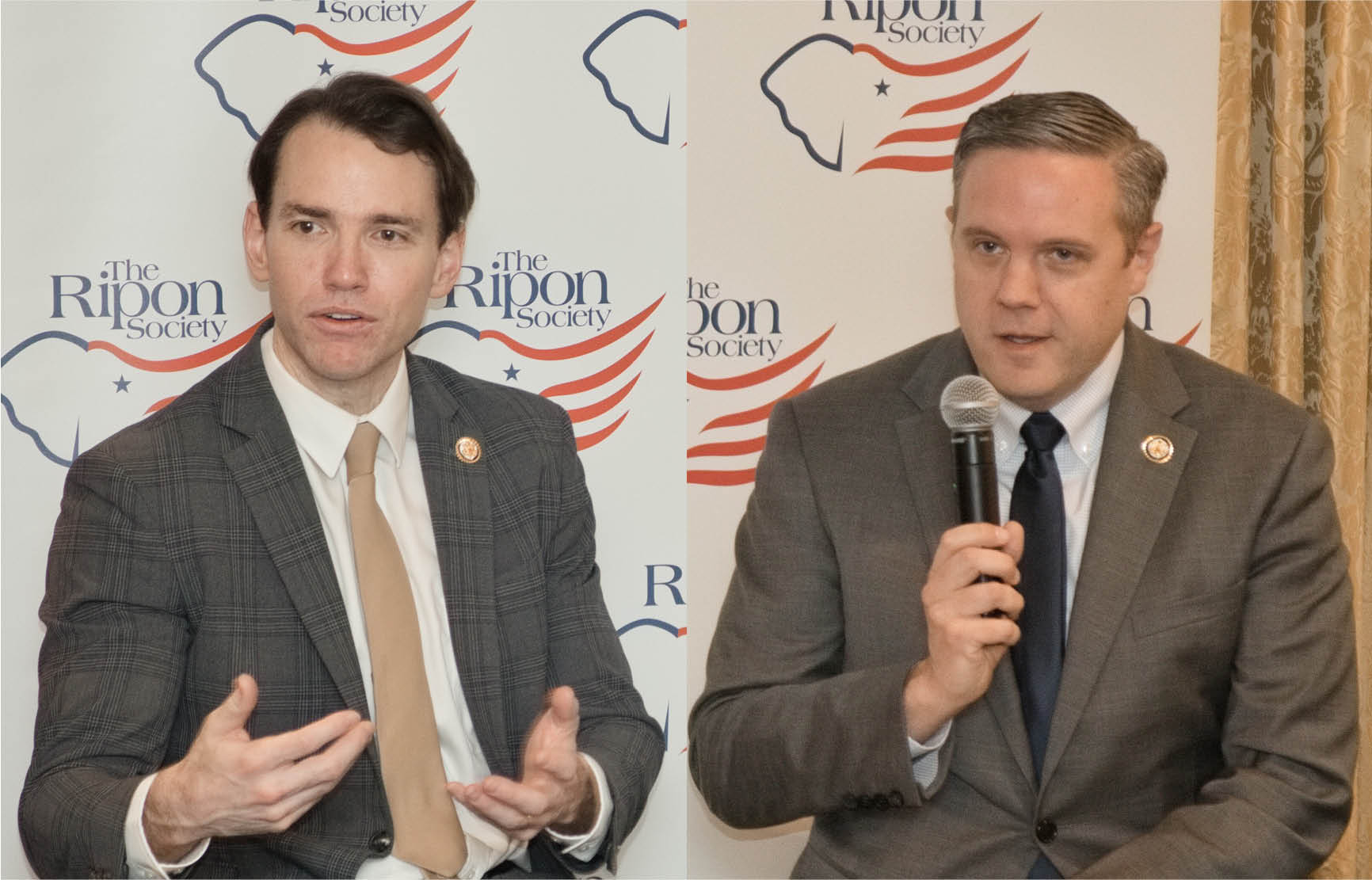
WASHINGTON, DC – Less than two weeks after the Supreme Court struck down many of the administration’s tariffs, two Republican Members of Congress appeared before a breakfast meeting of The Ripon Society yesterday morning to discuss what’s at stake for trade and Congressional authority.
The two members — Congressman Kevin Kiley (CA-03) and Congressman Jeff Hurd (CO-03) — both previously voted to disapprove of some of the administration’s trade actions, which the Court found exceeded presidential authority even under emergency powers.
Kiley, a former high school teacher and prosecutor, opened by framing the vote as a defense of two foundational principles.
“What we were standing for shouldn’t really be that controversial of a proposition,” Kiley stated in his opening remarks, “which is that Congress ought to have a role in trade policy— in a broad sense.
“I am a believer in the idea that the integration of markets and the magic of comparative advantage is one of the main drivers of the vast improvement to living standards in our modern world – both in terms of the wealth and comfort enjoyed in developed countries and the vast reduction in abject poverty in the developing world. That’s something that’s worth defending and fighting for.”
He went on to connect that economic conviction to a broader concern about the balance of power in Washington.
“I also think that protecting Article One in our Constitution is very important, in particular the prerogatives of the House of Representatives which is designed by the Framers to be the entity closest to the people. So, when you have a diminution in the power of the House of Representatives, that strikes a blow to representative government. And this issue we dealt with was an intersection of those two principles.”
Kiley also drew on his experience in the California legislature during the pandemic to underscore his concerns about unchecked executive authority.
“And that also brought in this issue of whether Congress should allow national emergencies to go on unchecked – which, I was in the legislature during the COVID years and was very unhappy about the sort of endless state of emergency we had in California and existed at the national level as well. And so, the idea that the House should not play its role of evaluating every six months whether national emergency conditions are still there, I thought was problematic as well.”
Hurd, a first-term legislator and lawyer, discussed the pressures that come with casting a principled vote.
“It’s tough. You get isolated in a way. You’re taking tough votes like this, and you’re standing on principle. … Standing up for what is right for your district, but also under the constitution.”
He then illustrated why his vote and the constitutional stakes extend well beyond the current administration.
“What do we say to the future president who declares a climate change emergency, and says that there is unlimited unilateral authority to implement tariffs on any and all energy-related products or anything in the energy industry? What is our principled response to that? We don’t have one if we don’t stand up here on something like this.”
Shifting to the practical case for congressional involvement, Hurd argued that industries and markets need stability more than anything else.
“I think we can price risk well, but uncertainty is much more difficult. Having that predictability is a strategic advantage when it comes to trade and trade policy and tariffs. Having Congress involved in that is something that is proper constitutionally. It’s good for us, I think electorally in our districts, but it’s also good in long term for business.
“I say this as somebody that shares President Trump’s goals of promoting domestic manufacturing, reshoring, onshoring critical industries, but strengthening alliances and reducing abuses that we have. We need to do it in a thoughtful way, in a strategic way.”
Hurd closed by reflecting on what the vote meant for his constituents and his colleagues alike.
“It was a great example for my constituents to show them that I’m fighting for them, for my colleagues, and standing up for our constitution.”
To view Kiley and Hurd’s remarks to The Ripon Society yesterday, please click the link below:
The Ripon Society is a public policy organization that was founded in 1962 and takes its name from the town where the Republican Party was born in 1854 – Ripon, Wisconsin. One of the main goals of The Ripon Society is to promote the ideas and principles that have made America great and contributed to the GOP’s success. These ideas include keeping our nation secure, keeping taxes low and having a federal government that is smaller, smarter and more accountable to the people.