



“We have the money. What we don’t have is the energy and the regulatory structure in which to compete.”
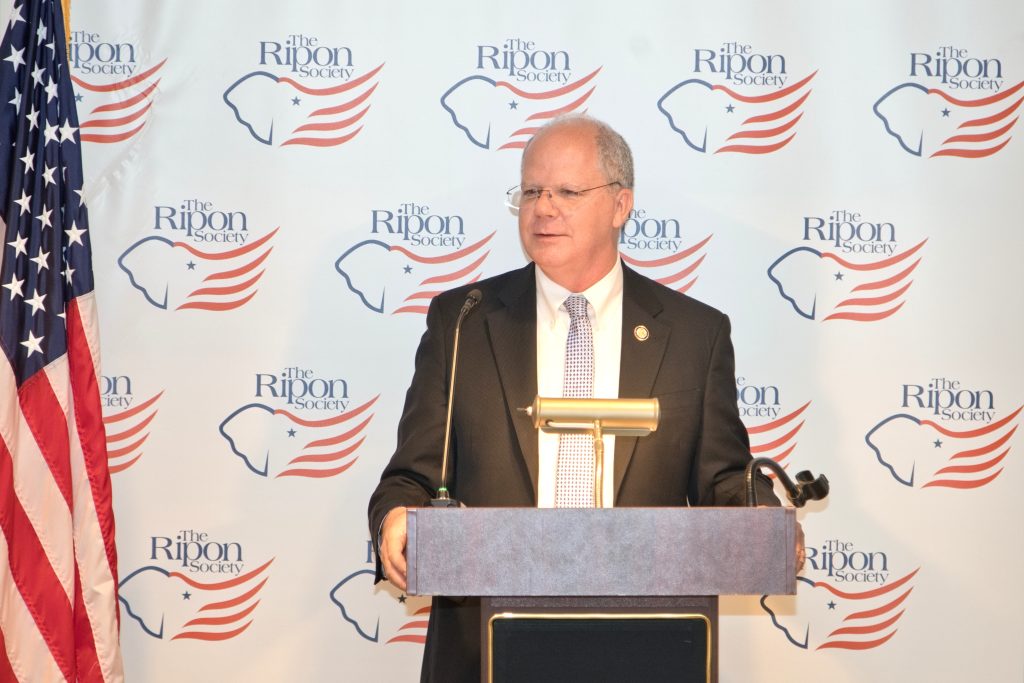
WASHINGTON, DC – House Energy and Commerce Committee Chairman Brett Guthrie (KY-02) addressed a breakfast meeting of The Ripon Society yesterday morning, laying out the committee’s legislative agenda across energy infrastructure, digital policy, healthcare, and critical minerals.
Guthrie opened on healthcare, framing price transparency as one of the committee’s most immediate and achievable goals.
“Healthcare price transparency is going to be extremely important,” he said. “It’s one of the few industries where people don’t even know what they’re paying for when they pay for it, how they pay for it, or where the money goes once they pay for it. We want transparency so people can see and make decisions. And if there’s excess profits in healthcare, then the competition will come.”
Guthrie then turned to artificial intelligence, which he described as the defining geopolitical contest of the era.
“The people that are in this space and this world say we have the brain power. We are always ahead of China. We have the money. What we don’t have is the energy and the regulatory structure in which to compete.”
He pushed back against proposals to restrict data center construction, warning that the stakes of falling behind China on AI infrastructure are simply too high.
“You’ve seen Bernie Sanders and Alexandria Ocasio-Cortez propose a moratorium on data centers in America. I always try to look at this kind of era of like maybe in the 1890s and 1880s when the railroads and all those other things were coming and if you wanted the equivalent of – let’s just ban railroads. Well, if they built one from Shanghai to Beijing and we didn’t build one, that wouldn’t affect us that much. But if they build data centers from Shanghai to Beijing and we don’t build them, it affects us tremendously.
“And it’s not just left — [it’s] right leaning too, you see this in a lot of local communities where data centers are looking to locate. And so that’s where we have to focus. We have to win the battle against China.”
Central to that effort, Guthrie said, is fixing a permitting process that routinely delays energy projects by years — and in some cases, kills them entirely.
“We have the energy, we have the ability to produce the energy, we have the resources. The question is: how do we get the energy to where it needs to be? How do we get it approved? How do we get it moving forward? And it gets tied up five to ten years to do energy projects because of the permitting process.”
At the same time, Guthrie was clear that streamlining federal permitting should not come at the expense of local authority.
“We want local communities to say where their projects can go. We don’t want to go in and say Bowling Green, Kentucky, has no say where a data center goes.”
Guthrie then turned to critical minerals, describing what he called a largely underreported supply chain crisis that served as a stark reminder of American vulnerability.
“A lot of people didn’t realize this – last spring when some of the trade wars were going on with China, China stopped sending critical minerals to America and essentially shut down the automotive industry for three or four days.
“We have these minerals here – we just don’t mine them here. Some of it’s permitting, some of it is that every time we try to produce them, China floods the markets so it lowers the price so people don’t put the money here.
“And there’s no American process. It’s all in China. And so, we’re looking at what do we need to give to the White House? What changes do they need so we can get this on? Because if China had done it longer, we would’ve been completely shut down.”
The Ripon Society is a public policy organization that was founded in 1962 and takes its name from the town where the Republican Party was born in 1854 – Ripon, Wisconsin. One of the main goals of The Ripon Society is to promote the ideas and principles that have made America great and contributed to the GOP’s success. These ideas include keeping our nation secure, keeping taxes low and having a federal government that is smaller, smarter and more accountable to the people.