



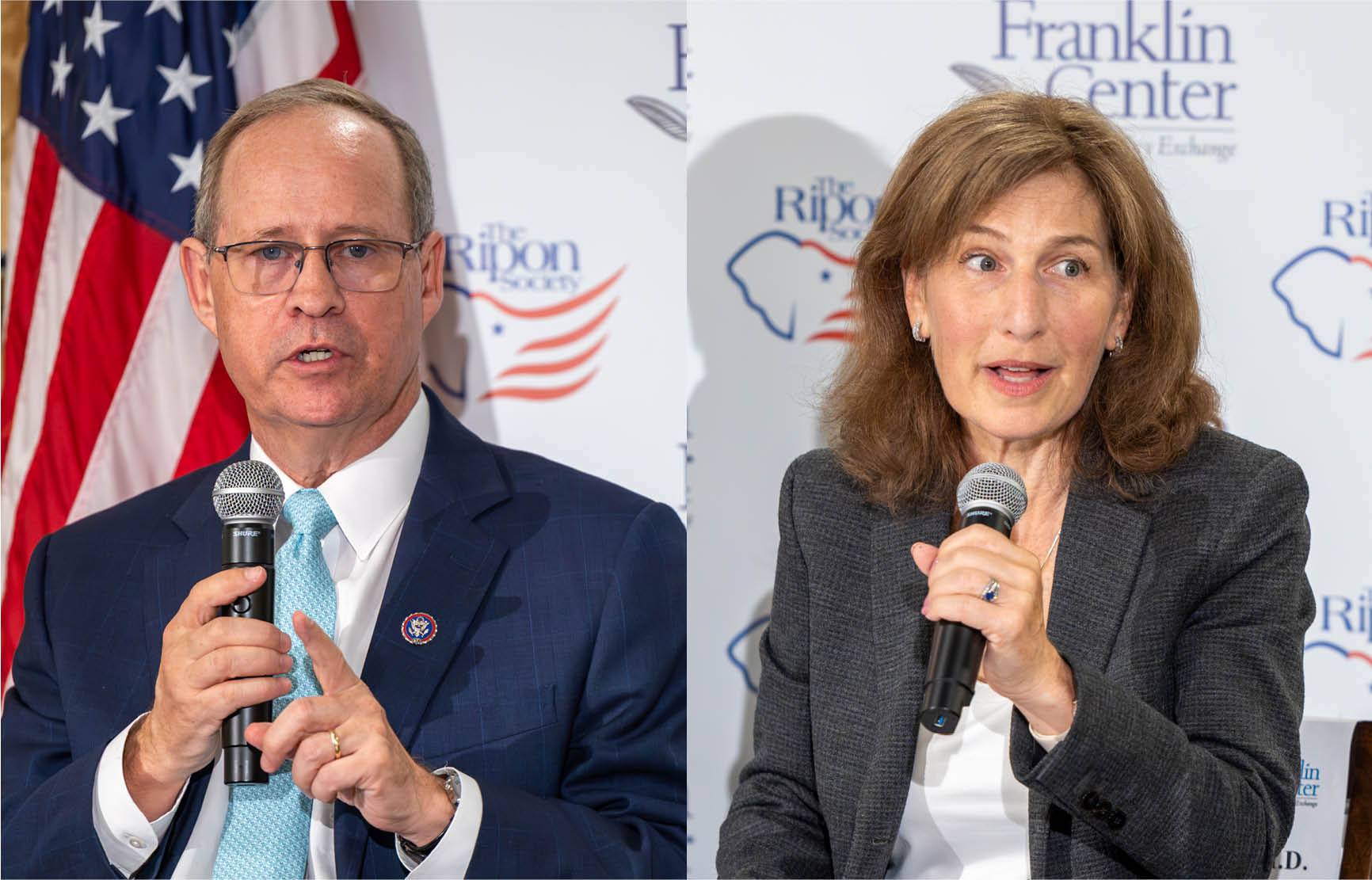
“In a very divided time, we’re working closely together. Democrats and Republicans agree on a lot, especially if we have the shared background of working in medicine and taking care of patients.”
WASHINGTON, DC – As health care costs continue to rise across the country, two bipartisan leaders who are both elected officials and medical professionals appeared before a breakfast meeting of The Ripon Society and The Franklin Center for Global Policy Exchange Tuesday morning to discuss their shared goal of reforming American health care and putting patients first.
The speakers were Congressman Greg Murphy, M.D. (R-NC-03), Chair of the GOP Doctors Caucus, and Congresswoman Kim Schrier, M.D. (D-WA-08), Chair of the Democratic Doctors Caucus.
Schrier, a pediatrician by trade, opened the conversation by describing the scale of the crisis facing patients and providers alike.
“We are all feeling the strains on the health care system. Patients are having trouble accessing physicians, physicians are getting burnt out, resigning, retiring early. … What we’re hearing from our constituents is just high copays, high deductibles, they can’t afford to see the doctor, and a real crisis, not just in the making, is already here. This is a place where as doctors and medical students, we’ve all gone through the same life experience or similar in taking care of patients. And so, we really understand what we need to do. The question is, where do we start?”
She pointed to reforming the Medicare physician fee schedule as one concrete place to begin.
“One of the things that we’ve been working on is reforming the Medicare physician fee schedule because it has not been keeping up. Over 25 years, reimbursement has dropped by about a third if you account for the cost of running a business and everything else. And I can’t think of another profession where people would stick around if their compensation dropped by a third. So, when you think about areas like rural areas that are very dependent on Medicare and Medicaid, this has an especially big impact. And so, Dr. Murphy, Dr. Joyce and myself work together to make changes to this reimbursement fee schedule that not only lift up all doctors to hopefully keep them in practice, but also put special emphasis on independent practices so they don’t get gobbled up by big hospital systems or private equity.”
From there, Schrier turned to another shared frustration: the role insurance companies play in medical decision-making.
“We’re also all incredibly frustrated. We have Democratic and Republican doctor caucuses, but we get together because we understand this whole prior authorization business that puts medical decision making in the hands of insurance companies is just plain wrong. They don’t have to deal with medical malpractice insurance and they’re not the ones who have to go explain to a patient that the treatment that the physician recommends will not be allowed by the insurance company. That’s just an awful position for us to have to be in. And so, we together co-sponsored the Reducing Medically Unnecessary Delays in Care Act to make sure that actual licensed physicians who practice in the field are the ones making those decisions about whether something’s authorized or not authorized – and not AI.”
Schrier closed with a reminder of what unites the two caucuses.
“In a very divided time, we’re working closely together. Democrats and Republicans agree on a lot, especially if we have the shared background of working in medicine and taking care of patients.”
Murphy, a urologist who is the only practicing physician in Congress, echoed Schrier’s call for bipartisanship before turning to what he sees as the central driver of the crisis: consolidation within the insurance industry.
“This is where these ridiculous partisan lines just drop down. Doctors tend to work together,” Murphy said. “I actually still see patients. I have a very, very loyal patient base of over 35 years. And then honestly, most importantly, it helps me say ‘this is what happened in the operating room, this is what happened in the office, this is what happened in the hospital.’”
Murphy then laid out what he sees as the root cause of rising costs.
“The last 15 years have seen a consolidation and my opinion is the primary driver of high cost of health care today. It’s consolidation within the insurance industry,” Murphy continued. “The fact that the third largest corporation in this country is UnitedHealthcare, is an insurance agency that earned in the first quarter this year $5 billion in profits. There’s something wrong with that. And the number one cause of medical bankruptcy is healthcare. There’s something wrong with that.”
Murphy also shared a personal account of navigating prior authorization denials as a patient himself, describing a months-long appeals process to get a prescribed medication approved.
“I did this purposely to see how many hoops we would have to jump through,” he shared. “The average patient would have given up after two. The insurance industry has built a system of obstruction, denial and delay. This cannot happen.”
He closed by returning to the theme of shared purpose across party lines.
“It’s not what’s good for the doctor, it’s not what’s good for the hospital, it’s not what’s good for the insurance company, it’s what’s good for the patient. And I wish and pray that this town would get back and understand that that’s our primary directive.”
To view Schrier and Murphy’s remarks before The Ripon Society and Franklin Center Tuesday morning, please click the link below:
The Ripon Society is a public policy organization that was founded in 1962 and takes its name from the town where the Republican Party was born in 1854 – Ripon, Wisconsin. One of the main goals of The Ripon Society is to promote the ideas and principles that have made America great and contributed to the GOP’s success. These ideas include keeping our nation secure, keeping taxes low and having a federal government that is smaller, smarter and more accountable to the people.
Founded in 1978, The Franklin Center for Global Policy Exchange is a non-partisan, non-profit 501(c)(3) organization committed to enhancing global understanding of important international issues. The Franklin Center brings together Members of the U.S. Congress and their international parliamentary counterparts as well as experts from the Diplomatic corps, foreign officials, senior private sector representatives, scholars, and other public policy experts. Through regular conferences and events where leading international opinion leaders share ideas, the Franklin Center promotes enlightened, balanced, and unbiased international policy discussion on major international issues.