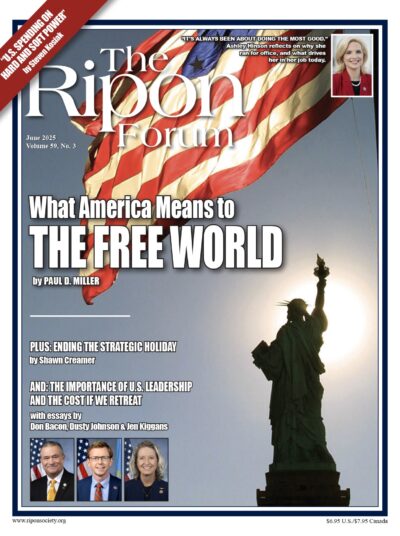

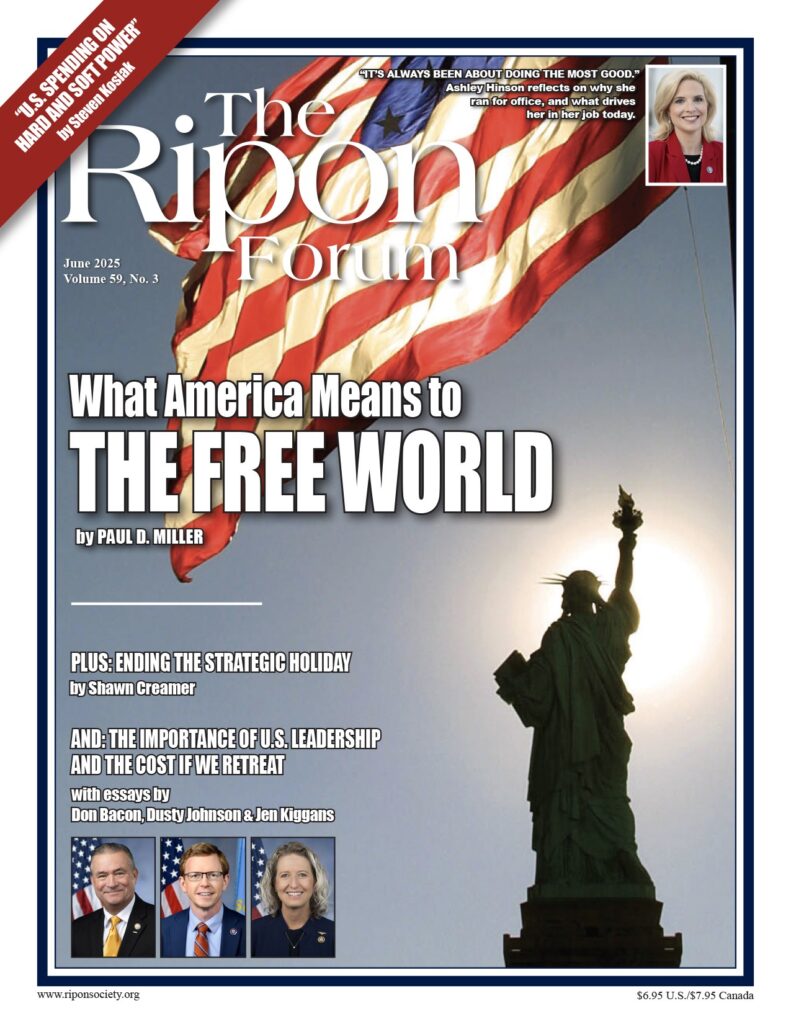
Less than a week after American bombers struck three nuclear weapons facilities in Iran, the latest edition of The Ripon Forum examines what the United States means to the free world with a series of essays about the importance of U.S. leadership and why this leadership will be critical to keeping the world peaceful, prosperous, and free in the coming years.
“The free world is good for America, and America is good for the free world,” writes Georgetown University Professor Paul D. Miller in the lead essay of this latest edition. “Today the free world has enemies abroad and doubts at home. China and Russia are mounting a full-spectrum assault on the free world; Iran and North Korea are smaller satellites to their efforts. Russia’s invasion of Ukraine, Iran’s proxy attack on Israel, and China’s maneuvering against Taiwan are not isolated developments. They are all attacks on the free world order.”
“We should face the threat the same way we always have. American grand strategy at its best always aims to preserve and expand American power by preserving and expanding American ideals. Power and justice go hand-in-hand. They are the twin pillars — better yet, the two fists — of an effective strategy. Power without justice is cynical and immoral; justice without power is weak and naïve. Together, they are tough-minded but morally aspirational, focused on American interests but mindful of our impact on the world at large. That means, first, American power — and the power of our free world allies — must remain unmatched.”
Nebraska Congressman and retired Air Force Brigadier General Don Bacon agrees. “America’s global leadership faces unprecedented tests as authoritarian regimes grow more aggressive across Europe, the Indo-Pacific, and the Middle East,” the lawmaker writes. “We must stand united with the world’s strongest coalition of democratic nations to confront these threats. However, the strength of this alliance depends on more than statements and symbolism. It demands action and an American resolve backed by real capability.”
Dusty Johnson, who represents South Dakota in the U.S. House and Chairs the Republican Main Street Caucus strikes a similar note in his essay. “America is safer and more secure when we have an engaged and strong presence in global affairs,” Johnson writes. “In the face of international conflict, America has a choice – to lead or retreat. In stark contrast to our former president, President Trump has chosen to lead. This decision affects the whole world as countries look to how America responds to threats of war, invasions, and attacks on our allies. They look to America’s leadership.”
According to Virginia Congresswoman and Navy veteran Jen Kiggans, this leadership is long overdue. “During President Biden’s Administration,” she writes, “threats abroad reached critical levels. Russia began a full-scale invasion of Ukraine, China became increasingly aggressive towards Taiwan and internationally, and Iran supported, and continues to support, violent terrorism in the Middle East. While thankfully not in our backyard, these events pose a very real threat to our peace here at home and thus require American leadership to ensure those who seek to harm our interests are kept in check or defeated.”
In other essays examining the importance of U.S. leadership in the face of increasing global threats, Atlantic Council senior fellow and retired U.S. Army Colonel Shawn Creamer writes about the rise of China and why it is time for the U.S. to end what he argues is a three decade-long “strategic holiday” and take this threat seriously. Steven Kosiak of the Quincy Institute examines U.S. spending on hard and soft power and shares his thoughts about where the Trump Administration is spending too much, and far too little. Robert Peters of the Heritage Foundation discusses the need for America to modernize its nuclear arsenal. And Justin Logan of the Cato Institute provides a preview of the upcoming NATO Summit in the Hague and why he believes it is time for the President to rebalance the transatlantic alliance.
Johns Hopkins Professor Judd Walson squares off with Brett Schaeffer of the American Enterprise Institute in a debate over America’s withdrawal from the World Trade Organization. And in the latest Ripon Profile, Iowa Congresswoman and former journalist Ashley Hinson reflects on why she ran for political office, and what drives her in her job today.
We hope you find this edition of The Ripon Forum interesting and informative, and, as always, we welcome any questions or comments you may have.
Lou Zickar
Editor of The Ripon Forum
louzickar@riponsociety.org