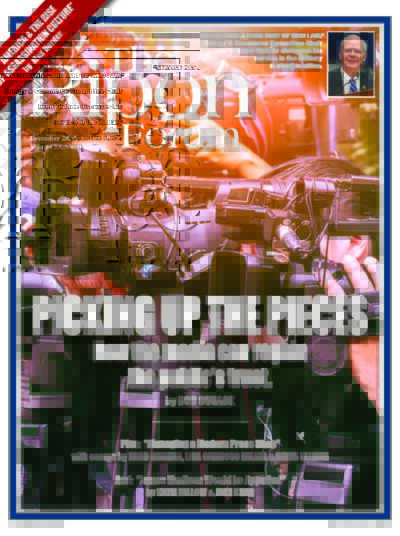

As America approaches the 250th anniversary of its founding, the relationship between the press and the public has reached a critical juncture. Trust in news institutions has plummeted to historic lows, while the very nature of how information flows through society has fundamentally transformed. In this edition of The Ripon Forum, we examine these seismic shifts and explore how the Fourth Estate can rebuild the confidence it has lost.
Bob Cusack, former editor-in-chief of The Hill newspaper, chronicles in our lead essay how the 2024 presidential election exposed deep fissures in media credibility. “I have covered politics in the nation’s capital for three decades,” he writes. “I didn’t realize there was bias in the media until I worked in the Fourth Estate.” Cusack argues that outlets accepting White House spin over their own reporting instincts — combined with failure to honestly report on President Biden’s declining mental acuity — have contributed to a crisis threatening the press industry’s very survival. His prescription is direct: “If you are covering news events for an outlet that purports to be down the middle, you cannot be an activist. You don’t take sides. Period.”
Three seasoned communications professionals also writing for this edition offer perspectives on managing press operations in this revolutionary moment. Brad Bauman, a principal at Raben’s Strategic Communications practice, observes that “the left and the Democratic Party have struggled to think past the broadcast mentality that defined our work prior to the digital age.” Today’s effective communication requires engaging influencers “who sometimes have followings in the 5,000-10,000 range, while not even talking to people whose audiences scale in the millions.” Lisa Camooso Miller, senior advisor at ROKK Solutions, notes that “today, there is no morning news cycle — only a constant one. A story can spark on a podcast, catch fire on social media, morph through commentary, and reach thousands before a traditional outlet even weighs in.” Yet Miller finds hope in continuity: despite faster platforms, the purpose of communications work remains unchanged from 1776 — inform, persuade, inspire, and move people to act. Chris Ullman, Founder and President of Ullman Communications, examines how “earned media is still important, but catching up quickly is ‘owned’ media: producing one’s own content and distributing it through websites and social media.” He advocates for hiring talented writers while cautioning that contracting content production often results in “safe and banal” work.
Katie Fallow and Jake Karr of the Knight First Amendment Institute document how the Trump administration has taken unprecedented steps to restrict press access. “The Founders understood that free speech is a fundamental freedom on which our representative democracy rests,” they write. When government provides access only to favored reporters, it exercises an impermissible “censorial power” that “poisons our information ecosystem and inhibits effective self-government.” Max Horder, a senior fellow at the Network Contagion Research Institute, explores a disturbing trend in online political discourse. When Luigi Mangione murdered UnitedHealthcare CEO Brian Thompson, social media exploded with celebration. “What’s happening on the internet is shaping and changing America in ways far beyond any of us can easily control — and are only beginning to understand,” Horder warns. His research revealed a high level of support among politically left-leaning respondents justifying the murder of President Trump.
Casey Mattox and Nick Krosse of Stand Together argue that government attempts to regulate AI “truthfulness” would be unconstitutional and counterproductive, contrasting America’s open approach with China’s authoritarian model. Spence Purnell of the R Street Institute examines AI’s impact on journalism, noting that Large Language Models can now verify claims at lightning speed while cautioning that the ideal future combines AI handling scale with humans supplying nuance. Kian Vesteinsson and Grant Baker of Freedom House document how governments have deployed increasingly sophisticated censorship measures over the past 15 years. They warn that U.S. foreign assistance cuts in early 2025 terminated critical funding for internet freedom programming, undermining organizations that have long defended against online censorship.
From the archives, we feature Dan Rather’s remarkably prescient 2007 essay examining how the 24/7 news cycle was transforming political coverage. Rather warned that continuous coverage too often prioritized “soft news, infotainment, and celebrity coverage” over substantive journalism. And in our latest Ripon Profile, Energy & Commerce Committee Chairman Brett Guthrie, who served in the 101st Airborne before his election to public office, discusses the important role that serving others has played in his life. “Service has always been a core part of who I am,” he states.
We hope you enjoy this edition of The Ripon Forum and, as always, welcome your comments.
Lou Zickar
Editor of The Ripon Forum
louzickar@riponsociety.org