
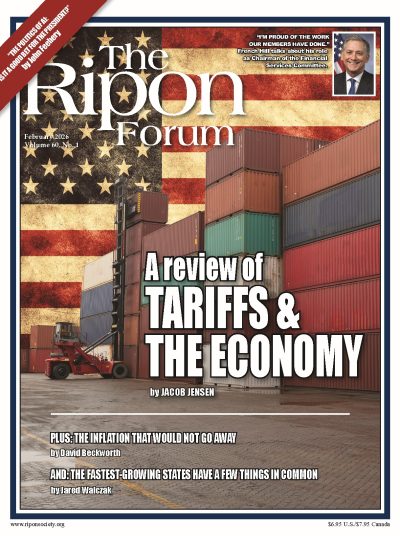

Just over one year into the Trump Administration and just under nine months until the mid-term elections, The Ripon Forum examines the state of the U.S. economy and some of the challenges facing American families and businesses in 2026.
In the cover essay for the latest edition, Jacob Jensen of the American Action Forum examines U.S. trade policy and the new tariff regime that has been put in place. “The tariff outlook has drastically changed over the past year, with the effective tariff rate skyrocketing from under 3 percent before President Trump’s inauguration to 28 percent post ‘Liberation Day,’” Jensen writes, adding that the tariff rate “now sits at roughly 14 to 16 percent.”
As for who is bearing the cost of these higher rates and policy changes, Jensen points to a study released last month, which found that: “96 percent of the tariff burden is being absorbed by U.S. businesses and consumers rather than foreign exporters, supporting past research from both The Budget Lab at Yale and the Harvard Business School. This means that U.S. taxes increased to the tune of $200 billion in 2025, counteracting the Trump Administration’s pro-growth deregulatory agenda and tax cuts.”
In another essay examining what is likely to be a key issue in the upcoming campaign, David Beckworth of the Mercatus Center looks at the rate of inflation, which, he notes, has gone down over the past 12 months but is still higher than it was before the Covid-19 pandemic. “Prior to the pandemic,” Beckworth writes, “inflation averaged 1.9 percent from 2016 through 2019. Since stabilizing in mid-2023, inflation has averaged about 2.9 percent, a full percentage point above the pre-2019 trend.”
Beckworth further notes that: “Households have taken notice of this apparent shift. Inflation continues to rank as a more important problem than unemployment in Gallup polling, even though the economy is now four years removed from the peak of the pandemic inflation surge. Notably, inflation’s elevated salience breaks a three-decade pattern in which unemployment typically dominated public concern during economic expansions.”
Romina Boccia of the Cato Institute delves deeper into how people view the economy with an essay examining consumer sentiment. “The Conference Board consumer confidence index has fallen for five consecutive months,” she writes. “While the University of Michigan survey showed a slight uptick in consumer sentiment in early February, the gains were concentrated among households with significant stock holdings, as ‘concerns about the erosion of personal finances from high prices and elevated risk of job loss continue to be widespread.’”
Boccia also writes that while elected officials in Washington have taken note of weak consumer confidence, “their prescribed solutions are mostly off base. Proposals range from price controls and ‘price gouging’ crackdowns to targeted subsidies, tariff dividends, and industry-specific relief (e.g. to farmers), alongside attempts to claim that the affordability crisis is a ‘hoax.’ The administration is further doubling down on tariffs to pressure allies, despite their effect of raising consumer prices. Politicians seem more focused on reallocating costs or assigning blame rather than addressing the policies driving up prices.”
In this time of economic uncertainty, it is worth noting that not all of the economic news is bad. Jared Walczak of the Tax Foundation recently examined the fastest growing states in the country to see what, if anything they had in common. He found that while they didn’t share a grand plan, they did share a common philosophy. What unites them is a belief in unleashing the power of markets,” Walczak writes.
In other essays for this edition of the Forum, Rob Atkinson of the Information Technology and Innovation Foundation examines whether we are in an artificial intelligence bubble or a boom, while veteran political strategist John Feehery assesses the politics of AI and whether it’s wise for the President to get out front on what, in this age of data centers and job losses, is becoming a very contentious issue.
Joshua McCabe of the Niskanen Center looks at the success of the Child Tax Credit and where Republicans should look next with regard to family-friendly tax policy. In the latest debate, Dennis Shea of the Bipartisan Policy Center and Roger Valdez of the Center for Housing Economics share their thoughts on the housing market and whether the government should get involved.
And in the latest Ripon Profile Arkansas Congressman French Hill discusses his role as Chairman of the Financial Services Committee and why he takes so much pride in the work his members have done.
As always, we hope you enjoy this edition of The Ripon Forum and welcome your comments.
Lou Zickar
Editor of The Ripon Forum
louzickar@riponsociety.org