



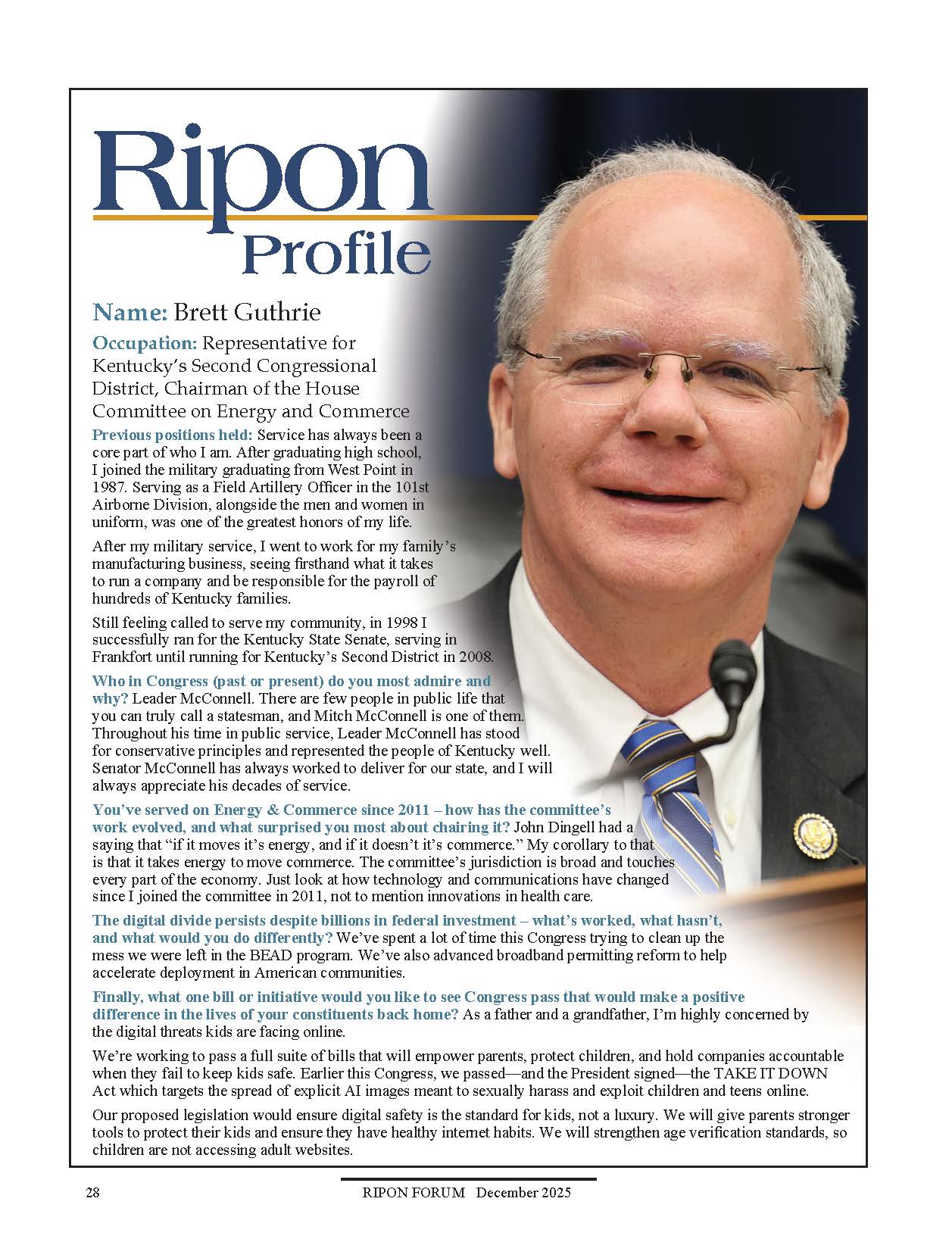
Name & Occupation: Brett Guthrie, Representative for Kentucky’s Second Congressional District, Chairman of the House Committee on Energy and Commerce
Previous positions held: Service has always been a core part of who I am. After graduating high school, I joined the military graduating from West Point in 1987. Serving as a Field Artillery Officer in the 101st Airborne Division, alongside the men and women in uniform, was one of the greatest honors of my life.
After my military service, I went to work for my family’s manufacturing business, seeing firsthand what it takes to run a company and be responsible for the payroll of hundreds of Kentucky families.
Still feeling called to serve my community, in 1998 I successfully ran for the Kentucky State Senate, serving in Frankfort until running for Kentucky’s Second District in 2008.
Coming to Washington in a historic Democrat trifecta in 2009 was a unique experience, and reaffirmed my commitment to the importance of responsible, conservative leadership. Over the past 17 years, I have had the honor of serving in various Republican Conference and House Committee leadership roles, including as a Deputy Whip, Chairman of the Subcommittee on Health, leading the Healthy Futures and Medicaid Task force.
Today, I am blessed to serve as Chairman for the House Committee on Energy and Commerce, where we are working to restore America’s energy dominance and lower energy prices, protect children’s online safety, ensure America remains the world leader in technological innovation, and protect access to life-saving treatments while lowering health care costs.
Who in Congress (past or present) do you most admire and why?
For me, that’s Leader McConnell. There are few people in public life that you can truly call a statesman, and Mitch McConnell is one of them. Throughout his time in public service, Leader McConnell has stood for conservative principles and represented the people of Kentucky well. Senator McConnell has always worked to deliver for our state, and I will always appreciate his decades of service.
You’ve served on Energy & Commerce since 2011 – how has the committee’s work evolved, and what surprised you most about chairing it? John Dingell had a saying that “if it moves it’s energy, and if it doesn’t it’s commerce.” My corollary to that is that it takes energy to move commerce. The committee’s jurisdiction is broad and touches every part of the economy. Just look at how technology and communications have changed since I joined the committee in 2011, not to mention innovations in health care.
We’ve seen energy move commerce in ways that we would have never thought were possible even a decade ago and that raises new challenges. Right now, we’re locked in a race with China to lead the world in the development and deployment of Artificial Intelligence. We cannot allow the Chinese Communist Party to set the pace and standards on this new and growing technology. Accordingly, we’ve seen a major uptick in the amount of energy required to secure our grid. We’ll continue to see new, unexpected challenges arise, but this Committee will always be the place for legislators to put Americans and our businesses at the leading-edge of technology, health, and energy production.
The digital divide persists despite billions in federal investment – what’s worked, what hasn’t, and what would you do differently? Providers face incredible challenges with permitting and red tape. We’ve spent a lot of time this Congress trying to clean up the mess we were left in the BEAD program. We’ve also advanced broadband permitting reform to help accelerate deployment in American communities. The Trump Administration has done a great job of cutting the worst of those regulations from the agency side, but we’re optimistic that we can work on legislation to make lasting changes that can’t be reversed by the stroke of a pen.
There’s still work to be done, but when we work with communities and broadband providers, there’s certainly a path forward to connect every household and provide all Americans with access to the 21st century digital economy.
Finally, what one bill or initiative would you like to see Congress pass that would make a positive difference in the lives of your constituents back home? As a father and a grandfather, I’m highly concerned by the digital threats kids are facing online. Big Tech has failed to self-regulate, and the status quo simply isn’t good enough.
We’re working to pass a full suite of bills that will empower parents, protect children, and hold companies accountable when they fail to keep kids safe. Earlier this Congress, we passed—and the President signed—the TAKE IT DOWN Act which targets the spread of explicit AI images meant to sexually harass and exploit children and teens online. That is massively consequential legislation, but it is still just a start.
Our proposed legislation would ensure digital safety is the standard for kids, not a luxury. We will give parents stronger tools to protect their kids and ensure they have healthy internet habits. We will strengthen age verification standards, so children are not accessing adult websites.
This is also our opportunity to end targeted advertising to kids and stop Big Tech’s attempts to create compulsive internet users out of our youngest generation. Strong, constitutionally-sound safeguards will help both parents and children as the internet continues to develop.