
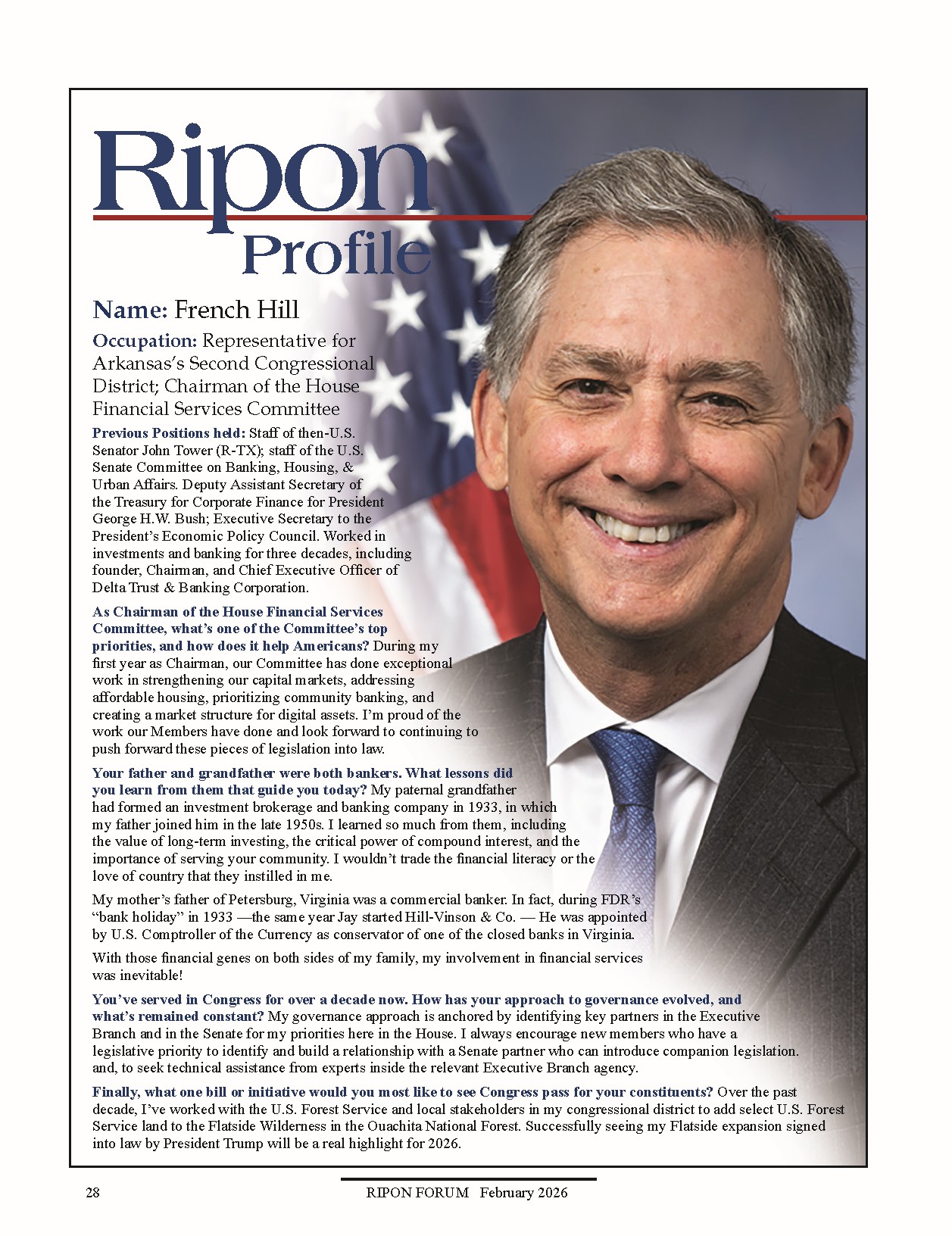
Name & Occupation: Congressman French Hill, Arkansas’s Second Congressional District since January 2015. He currently serves as Chairman of the House Financial Services Committee in the 119th Congress.
Previous Positions held: From 1982 until 1984, Chairman Hill served on the staff of then-U.S. Senator John Tower (R-TX), as well as on the staff of the U.S. Senate Committee on Banking, Housing, & Urban Affairs. He then went on to serve for President George H.W. Bush as Deputy Assistant Secretary of the Treasury for Corporate Finance from 1989 to 1991. In 1991, at the age of 34, President Bush appointed Chairman Hill to be Executive Secretary to the President’s Economic Policy Council (EPC), where he coordinated all White House economic policy. Prior to his congressional service, Chairman Hill worked in investments and banking for three decades. Most notably, he was founder, Chairman, and Chief Executive Officer of Delta Trust & Banking Corporation from 1999 until 2014, when Delta Trust was sold to Simmons Bank.
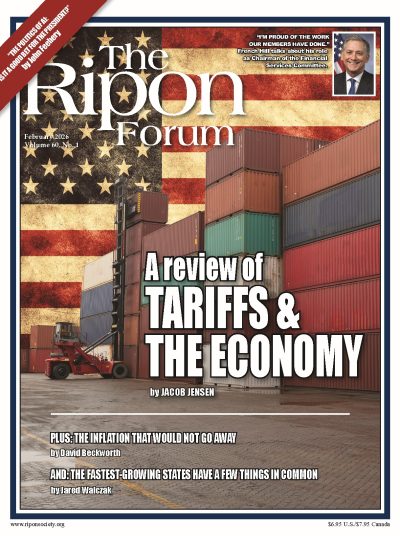
As Chairman of the House Financial Services Committee, what’s one of the committee’s top priorities, and how does it help Americans? As Chairman, it’s my goal to ensure our American financial system is safe, sound, and can thrive, all while maintaining our nation’s global leadership in all areas. During my first year as Chairman, our Committee has done exceptional work in strengthening our capital markets through the INVEST Act, addressing affordable housing through the Housing for the 21st Century Act, prioritizing community banking through the Main Street Capital Access Act, and creating a market structure for digital assets through the CLARITY Act. I’m proud of the work our Members have done and look forward to continuing to push forward these pieces of legislation into law.
Your father and grandfather were both bankers. What lessons did you learn from them that guide you today? I had a blessed upbringing in that I was very close to my grandfather and my dad. My paternal grandfather, Jay W. Hill, had formed an investment brokerage and banking company in 1933, in which my father, Jay F. Hill, joined him in the late 1950s. I learned so much from them, including the value of long-term investing, and the critical power of compound interest, and the importance of serving your community. Both of them were very civic-minded volunteers in our hometown of Little Rock, Arkansas. I wouldn’t trade the financial literacy or the love of country that they instilled in me.
Amazingly, my mother’s father of Petersburg, Virginia, Hal Payne, was a commercial banker. In fact, during FDR’s “bank holiday” in 1933 —the same year Jay started Hill-Vinson & Co. — Hal was appointed by the U.S. Comptroller of the Currency as a conservator of one of the closed banks in Virginia.
With those financial genes on both sides of my family, my involvement in financial services was inevitable!
You’ve served in Congress for over a decade now. How has your approach to governance evolved, and what’s remained constant? As a former congressional staffer in the Senate and a former senior official in the Executive Branch, my governance approach is anchored by identifying key partners in the Executive Branch and in the Senate for my priorities here in the House. I always encourage new members who have a legislative priority to identify and build a relationship with a Senate partner who can introduce companion legislation. And, to seek technical assistance from experts inside the relevant Executive Branch agency. This combination really enhances a member’s opportunity for success in seeing a great legislative idea turned into a law.
Finally, what one bill or initiative would you most like to see Congress pass for your constituents? Over the past decade, I’ve worked with the U.S. Forest Service and local stakeholders in my congressional district to add select U.S. Forest Service land to the Flatside Wilderness in the Ouachita National Forest. Arkansas is The Natural State and we pride ourselves on our extraordinary outdoor recreation resources. Successfully seeing my Flatside expansion signed into law by President Trump will be a real highlight for 2026.