

Inflation helped carry Donald Trump back to the White House. Running on the public’s frustration with the high prices of the pandemic era, he pledged to marshal the vast powers of the federal government to bring down the cost of living and end what he called America’s affordability crisis. So how has inflation fared under the Trump Administration over the past year? The good news is that inflation appears anchored. The bad news is where it has settled: almost a full percentage point above the Federal Reserve’s 2 percent inflation target. Worse still, many households continue to view inflation as a major concern, shaped by the lingering trauma of the 2021–2023 inflation surge, the price effects of tariffs, and growing unease about the nation’s long-term fiscal outlook.
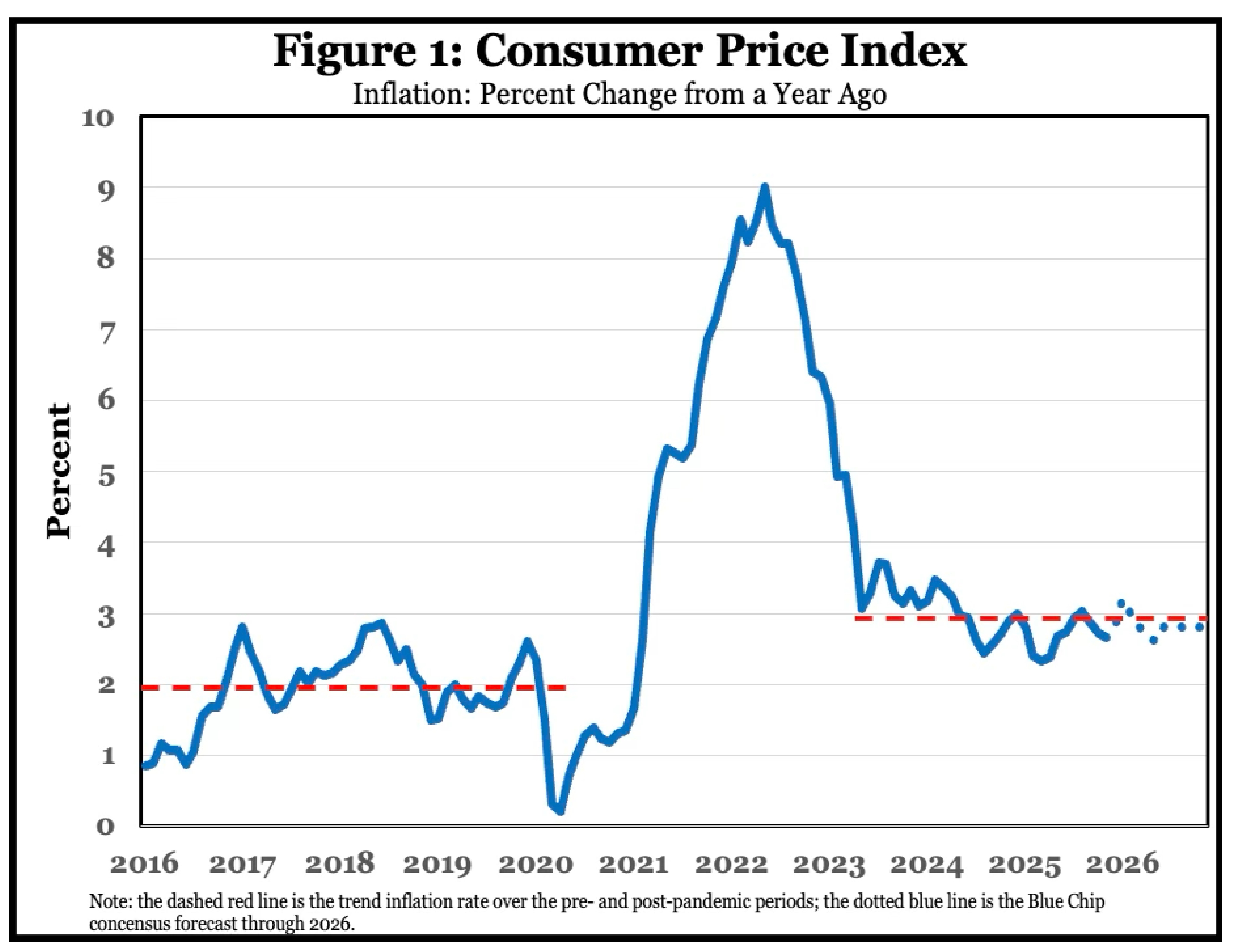
The inflation record underlying this assessment is summarized in Figure 1. Prior to the pandemic, inflation averaged 1.9 percent from 2016 through 2019, as indicated by the left-hand dashed red line. Since stabilizing in mid-2023, inflation has averaged about 2.9 percent, a full percentage point above the pre-2019 trend. This elevated but stable outcome is widely expected to persist through 2026, as shown by the dotted blue line representing the Blue Chip consensus forecast. In this sense, President Trump has inherited and maintained an inflation regime that is meaningfully higher than what prevailed before the pandemic, raising the possibility that 3 percent has become the new 2 percent in terms of trend inflation.
Prior to the pandemic, inflation averaged 1.9 percent from 2016 through 2019. Since stabilizing in mid-2023, inflation has averaged about 2.9 percent, a full percentage point above the pre-2019 trend.
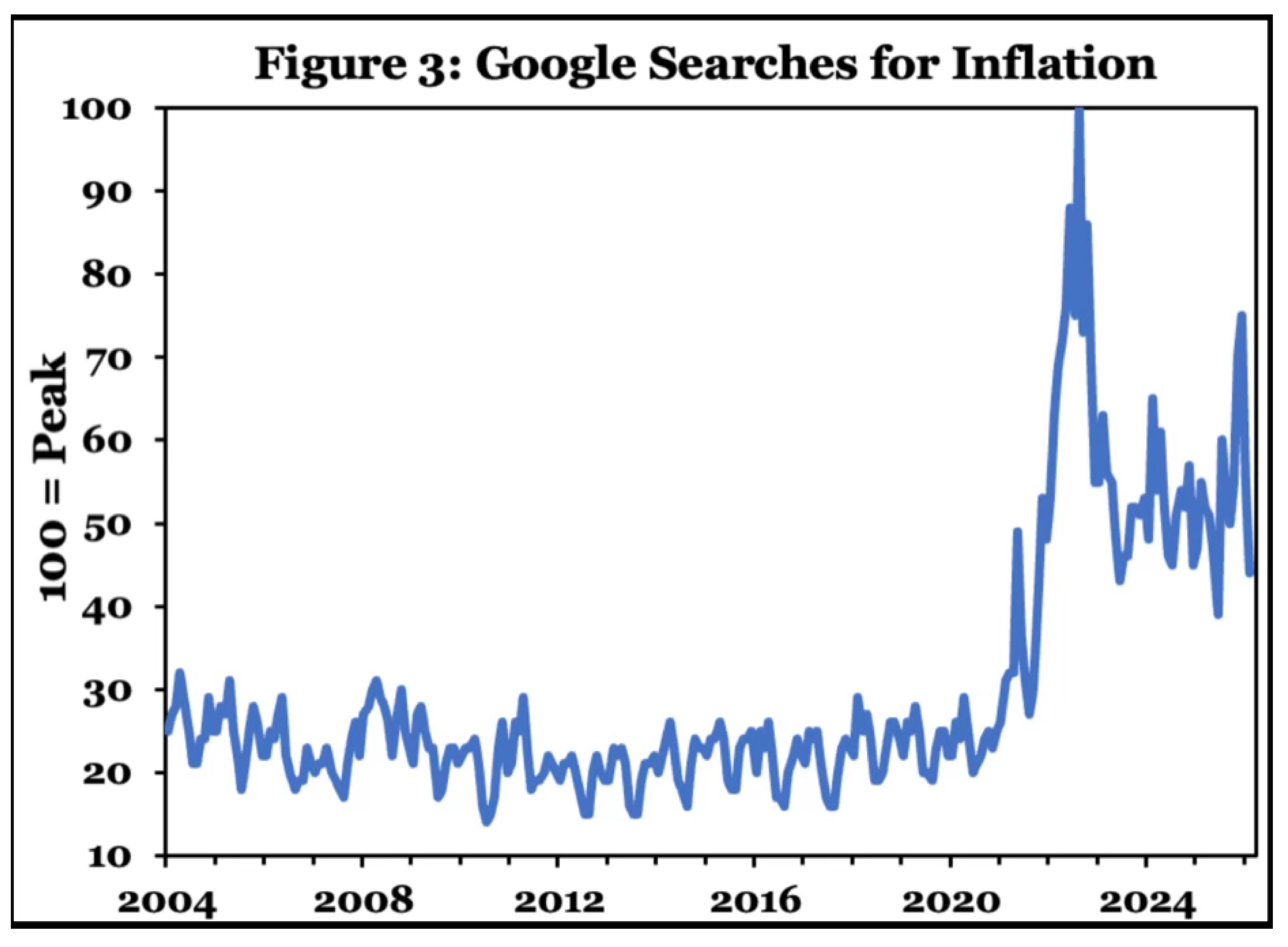
Households have taken notice of this apparent shift. As shown in Figure 2, inflation continues to rank as a more important problem than unemployment in Gallup polling, even though the economy is now four years removed from the peak of the pandemic inflation surge. Notably, inflation’s elevated salience breaks a three-decade pattern in which unemployment typically dominated public concern during economic expansions. Figure 3 suggests that these worries extend beyond survey responses and into actual behavior. Google searches for inflation remain nearly twice as high as their pre-pandemic levels, indicating a heightened sensitivity to price changes. This heightened attention probably reflects both the scarring effects of the 2021–2023 inflation episode and the higher level of trend inflation households have experienced since mid-2023.

Households have taken notice of this apparent shift. Inflation continues to rank as a more important problem than unemployment in Gallup polling, even though the economy is now four years removed from the peak of the pandemic inflation surge.
Why, then, has trend inflation remained elevated? Some observers point to President Trump’s tariffs, which have raised the prices of imported goods. Federal Reserve Chair Jerome Powell, for example, argued at the January 2026 FOMC meeting that tariffs account for much of the recent above-target inflation and that their effects should prove transitory. That explanation, however, struggles to account for why inflation has remained persistently near 3 percent since mid-2023.
Others argue that inflation remains elevated because the Federal Reserve failed to keep interest rates high for long enough to sufficiently slow spending and lower inflation. That critique cannot be dismissed out of hand, but a more compelling explanation, in my view, lies in the growing fiscal pressures now affecting the U.S. economy.
According to the Congressional Budget Office, federal deficits are projected to remain historically large over the next decade, pushing the public debt to near 120 percent of GDP. At the same time, higher interest rates have sharply increased the government’s debt-service costs, which the CBO expects to approach $2 trillion annually by the early 2030s. This deteriorating fiscal outlook increasingly constrains the environment in which monetary policy operates.
These developments suggest that fiscal dominance — a situation in which fiscal conditions rather than the Federal Reserve’s inflation target increasingly shape monetary policy outcomes — may be on the horizon. Under fiscal dominance, the central bank may ostensibly pursue price stability, but in practice faces growing pressure to keep interest rates lower than would otherwise be necessary in order to contain government borrowing costs and preserve financial stability. Importantly, this pressure need not come in the form of formal interference or a loss of statutory independence. It can emerge more subtly, as political leaders and market participants begin to view monetary policy through a fiscal lens. President Trump’s repeated calls for the Fed to cut interest rates in order to reduce federal debt-service costs are a clear illustration of this shift, as are recent proposals in Congress to eliminate interest on reserves or loosen bank leverage rules so that financial institutions can absorb larger quantities of Treasury debt. Taken together, these developments suggest a growing risk that the Fed may tolerate somewhat higher inflation as the path of least resistance in an increasingly fiscally constrained environment.
The political irony is hard to miss. Donald Trump returned to office promising relief from inflation and the affordability crisis. Yet if fiscal pressures continue to mount, inflation may remain stuck above target — or even reaccelerate — just as voters head toward the 2026 midterm elections. In that case, the very economic issue that helped propel Trump back to the White House could once again shape the political landscape, this time not as a transient shock but as a symptom of a more deeply constrained inflation regime.
David Beckworth is a Senior Research Fellow at the Mercatus Center at George Mason University and director of the Mercatus Center’s monetary policy program. He is the host of Macro Musings, a weekly podcast on macroeconomics, where, since 2016, he has interviewed hundreds of experts, including regional presidents of the Federal Reserve, Nobel laureates, and leading academics from around the world. He is the author of Boom and Bust Banking: The Causes and Cures of the Great Recession (Independent Institute, 2012).