

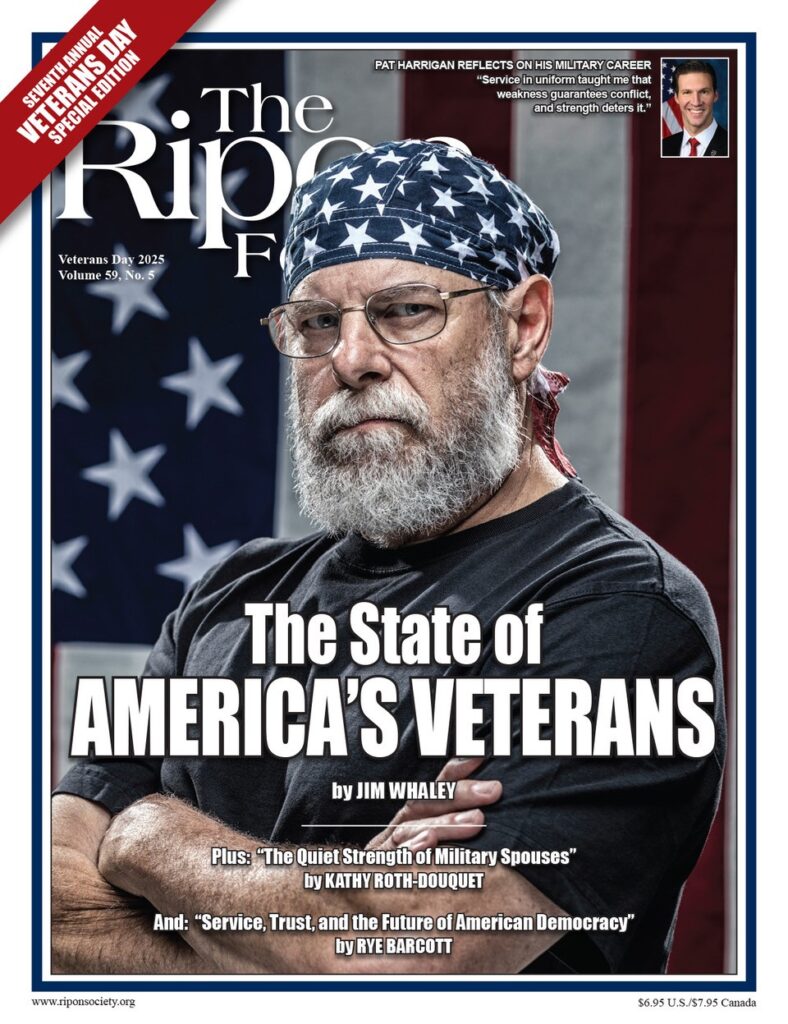
With Veterans Day approaching and for the seventh consecutive year, The Ripon Forum is dedicating an entire edition to those who served our country in uniform, a group of Americans that is not only smaller now than at any point in modern history, but is also more diverse and dispersed.
“Today, there are about 17.5 million veterans in the United States, representing roughly 6–7 percent of the adult population,” writes Jim Whaley in the lead essay. “That’s a dramatic shift from the decades following World War II, when veterans made up 10–15 percent of U.S. adults. By 2040, that share is projected to drop below 5 percent, and the total veteran population is expected to fall to around 13 million.”
Whaley is a 20-year Army veteran who now serves as CEO of Mission Roll Call. In his essay, he also examines how the veteran population in the U.S. is changing, and the possible policy implications of these changes in the years ahead.
“As the community shrinks,” he writes, “it is also becoming more diverse. Roughly 19 percent of veterans are now people of color, compared to less than 10 percent in 2000, and the number of women veterans is steadily rising, expected to make up nearly 18 percent of the total by 2040. Veterans are also geographically dispersed: about 4.7 million, more than one quarter of all veterans, live in rural communities, where access to healthcare, transportation, and employment can be especially challenging…”
“The population is also aging. Nearly half of all veterans are over the age of 65, and more than 40 percent live with a service-connected disability. Many are managing the long-term physical and mental health consequences of service, from chronic pain and toxic exposure to post-traumatic stress and traumatic brain injury. These realities shape the kind of care, support, and policy solutions they need.”
The veteran community may be changing, but according to former Marine Rye Barcott, veterans collectively remain some of the most trusted individuals in the United States. Barcott now serves as the CEO of With Honor, another advocacy organization which, along with Gallup, recently conducted a poll to gauge how Americans perceive veterans. The poll, Barcott writes, “reveals something extraordinary … In an era where cynicism about government is pervasive, the perception of veterans as trusted, mission-driven leaders represents one of the few bipartisan points of agreement left in American politics.”
In another essay for this Special Edition, Kathy Roth-Douquet writes about “The Quiet Strength of Military Spouses.” Roth-Douquet is the founder and CEO of Blue Star Families. She is also the wife of a retired Marine who raised a family through four deployments and nine moves. In her essay, she examines the challenges facing military spouses today, including the fact that an increasing number have to work.
“According to the 2024 Blue Star Families Military Family Lifestyle Survey,” she writes, 77 percent of active-duty families say having two incomes is vital to their financial well-being, up sharply from 63 percent in 2019.”
Other veteran advocates featured in this edition include Besa Pinchotti, the CEO of the National Military Family Association, writing about the Army’s efforts to modernize infrastructure to improve the quality of life for military families, and Will Thibeau, a former Army Ranger who is now the Director of the American Military Project at the Claremont Institute, writing about the legacy of service in the military and the fact that over 80 percent of Army recruits have a family member who served, as well.
In other pieces, National Governors Association Chair Kevin Stitt examines some of the actions being taken by America’s governors to assist America’s veterans. U.S. Senators Jerry Moran and Richard Blumenthal, who serve as the Chairman and Ranking Member of the Veterans Affairs Committee, write about their bipartisan efforts to keep America’s commitment to those who served. And U.S. Senator Todd Young, a Navy veteran himself, writes about a subject that should be important to all veterans and all Americans — the need for the U.S. to invest in shipbuilding again.
Maryland Governor Wes Moore, along with U.S. Representatives Tom Barrett, Gil Cisneros, Gabe Evans, and Maggie Goodlander, write about their service in uniform, the importance of Veterans Day, and what the holiday means to them. And in our latest Ripon Profile, U.S. Representative Pat Harrigan discusses his own military service and how it shapes his service on Capitol Hill.
We hope you enjoy this 7th Annual Special Veterans Day Edition of The Ripon Forum, and, as always, we welcome any questions or comments you may have.
Lou Zickar, Editor
louzickar@riponsociety.org