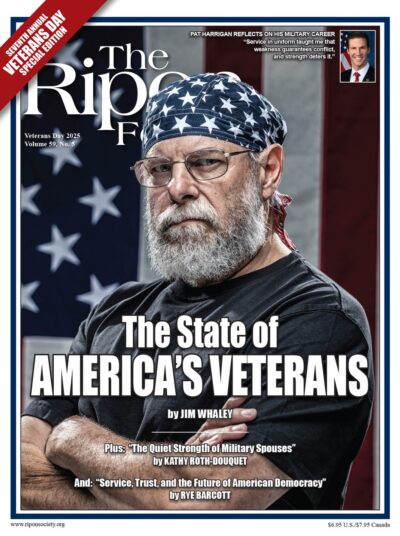

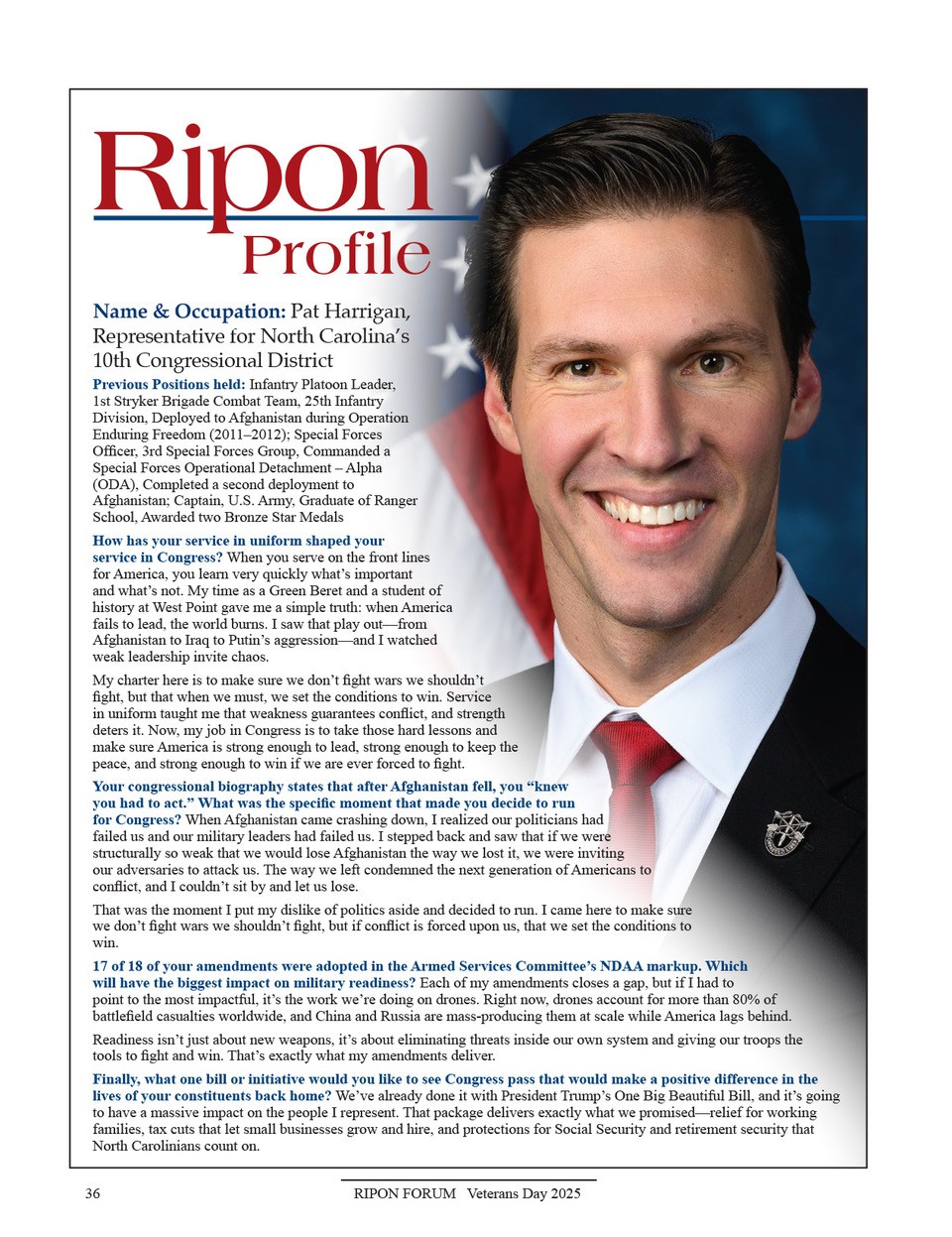
Name & occupation: Pat Harrigan, Representative for North Carolina’s 10th Congressional District
Previous Positions held: Infantry Platoon Leader, 1st Stryker Brigade Combat Team, 25th Infantry Division, Deployed to Afghanistan during Operation Enduring Freedom (2011–2012); Special Forces Officer, 3rd Special Forces Group, Commanded a Special Forces Operational Detachment – Alpha (ODA), Completed a second deployment to Afghanistan; Captain, U.S. Army, Graduate of Ranger School, Awarded two Bronze Star Medals
How has your service in uniform shaped your service in Congress? When you serve on the front lines for America, you learn very quickly what’s important and what’s not. My time as a Green Beret and a student of history at West Point gave me a simple truth: when America fails to lead, the world burns. I saw that play out—from Afghanistan to Iraq to Putin’s aggression—and I watched weak leadership invite chaos.
That’s why I ran for Congress. My charter here is to make sure we don’t fight wars we shouldn’t fight, but that when we must, we set the conditions to win. Service in uniform taught me that weakness guarantees conflict, and strength deters it. Now, my job in Congress is to take those hard lessons and make sure America is strong enough to lead, strong enough to keep the peace, and strong enough to win if we are ever forced to fight.
Your congressional biography states that after Afghanistan fell, you “knew you had to act.” What was the specific moment that made you decide to run for Congress? When Afghanistan came crashing down, I realized our politicians had failed us and our military leaders had failed us. I stepped back and saw that if we were structurally so weak that we would lose Afghanistan the way we lost it, we were inviting our adversaries to attack us. The way we left condemned the next generation of Americans to conflict, and I couldn’t sit by and let us lose.
That was the moment I put my dislike of politics aside and decided to run. I came here to make sure we don’t fight wars we shouldn’t fight, but if conflict is forced upon us, that we set the conditions to win. Because at the end of the day, there is no substitute for victory—and America cannot afford another generation of failed leadership.
17 of 18 of your amendments were adopted in the Armed Services Committee’s NDAA markup. Which will have the biggest impact on military readiness? Each of my amendments closes a gap, but if I had to point to the most impactful, it’s the work we’re doing on drones. Right now, drones account for more than 80% of battlefield casualties worldwide, and China and Russia are mass-producing them at scale while America lags behind. My SkyFoundry amendment establishes a national innovation center for unmanned systems and begins building the domestic capacity to produce a million drones a year. That’s the kind of shift that keeps our troops alive and keeps America competitive in modern warfare.
At the same time, I see real impact from cutting out Chinese-controlled companies from our bases and phasing Chinese-made ingredients out of our military medical supply chain. Right now, the Chinese Communist Party owns GNC through Harbin Pharmaceuticals and still operates more than 80 storefronts on U.S. military bases, including Fort Bragg in North Carolina. Those stores are in a position to collect personal data from our troops and funnel it straight back to Beijing. Allowing a hostile foreign government to run retail operations inside our own installations is reckless. My amendment shuts that door for good and makes sure the Pentagon can’t look the other way on vulnerabilities like this again.
In short, readiness isn’t just about new weapons, it’s about eliminating threats inside our own system and giving our troops the tools to fight and win. That’s exactly what my amendments deliver.
Finally, what one bill or initiative would you like to see Congress pass that would make a positive difference in the lives of your constituents back home? We’ve already done it with President Trump’s One Big Beautiful Bill, and it’s going to have a massive impact on the people I represent. That package delivers exactly what we promised—relief for working families, tax cuts that let small businesses grow and hire, and protections for Social Security and retirement security that North Carolinians count on. It tackles the cost of living by cutting taxes on tips and overtime, brings accountability back to Washington, and puts more money in the pockets of everyday Americans.
For my district, that means stronger paychecks, more jobs, and a government finally working for them instead of against them. It’s the single most consequential conservative policy win in a generation, and I’m proud to have had a hand in making it law.