





When people think of military service, they often picture uniforms, deployments, and acts of heroism overseas. That service however, is made possible by the military family — the spouses, the children, the parents, who are the life support system for the service member. That military spouse plays out their service every day across homes, schools, and neighborhoods, far from family and friends, facing their own struggles, often without the support they need. At Blue Star Families, the nation’s largest nonprofit supporting military and veteran families, we recognize that the strength of the nation is its military, and the strength of our military is the service member. The strength of the service member, however, is his or her family. Then who — who — will be the strength of the military family? It must be us, all of us.
Take the Love family, a Navy family with nearly two decades of service and nine moves. Their children have attended six different schools. This year, they relocated from Rhode Island to Mayport, Florida. Just days after arriving, Leah Love’s husband checked into his command – only to be flown out to meet his ship already at sea. By the weekend, his brief assignment had become a full deployment. The boxes were barely unpacked. Leah was alone. Again.
The strength of the nation is its military, and the strength of our military is the service member. The strength of the service member, however, is his or her family.
A typical day for families like the Loves means balancing parenting, work, and the complicated logistics of each new posting. School enrollment isn’t just paperwork; it means navigating vaccine records, athletic eligibility, and ensuring continuity for children constantly playing the “new kid.” When her sons wanted to try out for cross country, Leah hit repeated roadblocks scheduling an alternate tryout. She ultimately invoked the Military Interstate Children’s Compact (MIC3), which guarantees fair school transitions for military kids, to ensure her sons got a fair shot. Even well-intentioned communities can make transitions harder without understanding or flexibility.
Stories like the Loves’ are all too common. Each year, hundreds of thousands of military families face similar challenges — constant moves, job disruptions, and the daily effort to rebuild community and belonging.
And these daily challenges unfold against a backdrop of mounting financial strain.
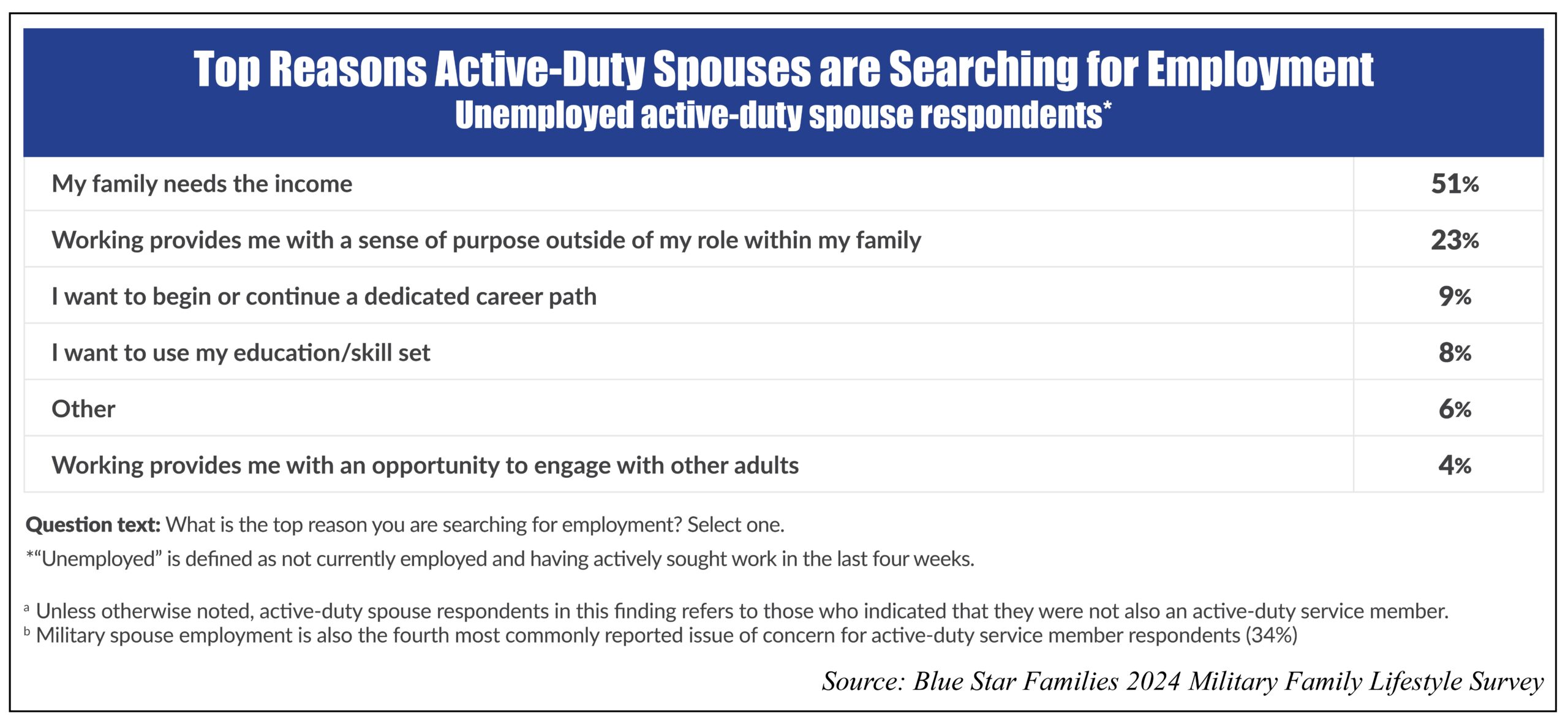
According to the 2024 Blue Star Families Military Family Lifestyle Survey, 77 percent of active-duty families say having two incomes is vital to their financial well-being, up sharply from 63 percent in 2019. Yet frequent moves, childcare shortages, and licensing barriers make sustaining dual incomes difficult. Childcare also remains one of the most pressing issues. The survey also found that 68 percent of active-duty spouses need childcare to work, but more than a third cannot find care that meets their needs. Nearly half say it simply doesn’t exist where they live. The result: families lose income, children lose stability, and service members lose focus – putting mission readiness at risk.
Yet, there’s opportunity. Communities that welcome military families strengthen their own neighborhoods. Military spouses are teachers, nurses, business leaders, PTA volunteers, and coaches. Their kids bring diversity and resilience to classrooms. Their families pay taxes, join churches, shop locally, and give back in ways that make towns stronger. But they can only do this if we meet them halfway.
According to the 2024 Blue Star Families Military Family Lifestyle Survey, 77 percent of active-duty families say having two incomes is vital to their financial well-being, up sharply from 63 percent in 2019.
That’s why Congress and the Administration must act now to:
- Strengthen MIC3 implementation nationwide. Ensure military children have consistent, equitable access to schools and athletics across all states by fully enforcing the MIC3.
- Expand quality-of-life provisions in the FY26 NDAA.Quality of life directly impacts mission readiness. Building on the progress made in FY25, Congress should pass Representative Chrissy Houlahan’s (D-PA) proposal to extend childcare fee assistance to in-home providers and guarantee families at least one year’s notice if the program is ever discontinued – giving them time to plan and adjust.
- Prioritize employment portability and flexibility. Encourage employers to adopt the 4+1 Commitment: The Formula for Military Spouse Success. This proven approach supports job transferability, remote work options, flexible hours, and paid PCS leave – helping families stay financially stable between moves.
- Raise the cap on Dependent Care Flexible Spending Accounts.The current $5,000 cap hasn’t changed in 35 years. Doubling it to $10,500 would better reflect today’s realities and give families meaningful financial relief.
These aren’t aspirational goals. They’re urgent, actionable, bipartisan solutions that would immediately improve daily life for families who serve.
Blue Star Families’ Do Your Part initiative provides simple, everyday solutions for all of us to contribute to the strength of the military family. No effort is too small. Ask your child’s school if they’re part of the Military Interstate Children’s Compact. Encourage your employer to adopt policies that make jobs portable and flexible for spouses who move often. Get to know the new family on your street. Invite them to coffee. Welcome them to the soccer team or book club.
Military spouses don’t wear the uniform, but their service is constant. This November, during National Military Family Month and as we honor our Veterans, let’s also honor the families who serve beside them — not with words, but with action. Because when military families feel at home, our country is stronger.
Kathy Roth-Douquet is founder and CEO of Blue Star Families, one of the nation’s largest nonprofits supporting military families. She is also a military spouse of 24 years, four deployments, and nine moves.