



Latest Ripon Forum looks at permitting reform, data centers, and an American strategy for global clean energy leadership
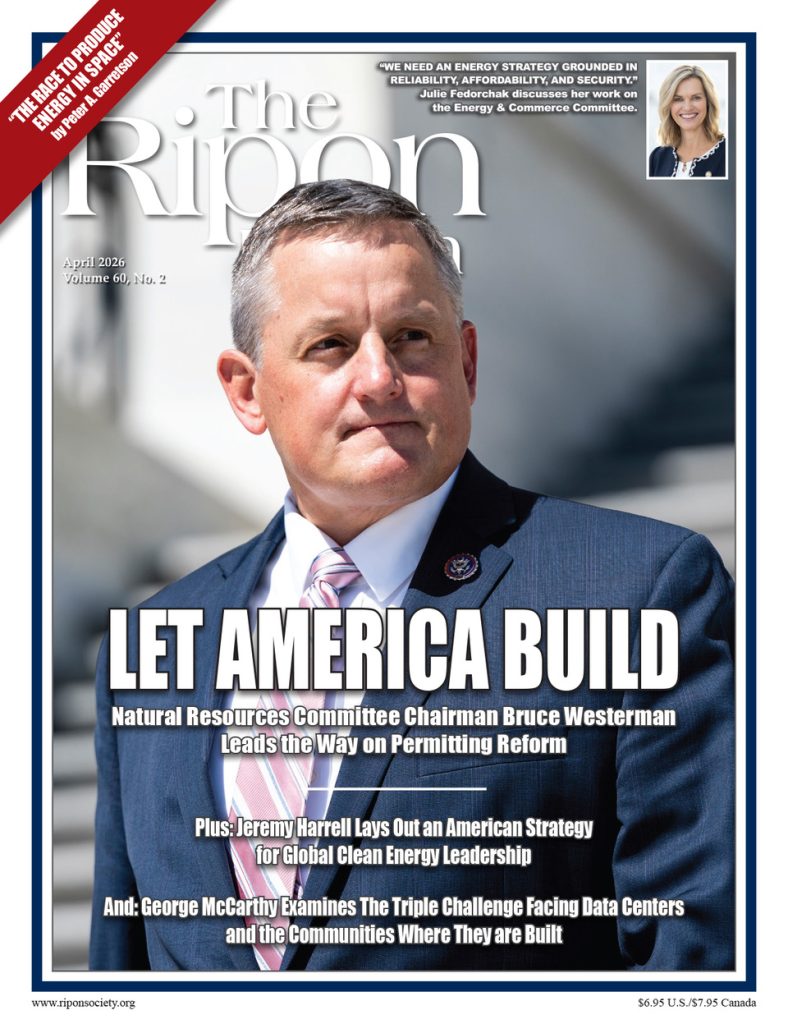
WASHINGTON DC — With energy costs rising at a time when energy demand is going through the roof, the latest edition of The Ripon Forum examines steps that should be taken to meet this demand and make energy more affordable for American families and businesses in the coming years.
Leading the Forum’s coverage of this important topic is Bruce Westerman. Westerman represents the 4th District of Arkansas in the U.S. House of Representatives. He also serves as Chairman of the Natural Resources Committee, where he is helping to lead the effort on Capitol Hill to reform the broken permitting process in America so our country can begin building and producing again.
“America produces energy and minerals cleaner, safer and more efficiently than anywhere else in the world,” Westerman writes in the lead essay for the Forum. “But those benefits cannot come to fruition if the infrastructure isn’t built … Our federal permitting process has opened the door to endless delays that drive up costs, halt economic growth and stifle American innovation. By fixing the permitting process, we will enable our nation to do what it does best – innovate, produce and build – and every American will benefit.”
According to Jeremy Harrell, the CEO of ClearPath, the U.S. has a lot of catching up to do in this regard, particularly when it comes to the production of clean energy. “Over the rest of this decade,” Harrell writes, “the world will need to add thousands of gigawatts of new power capacity driven by the expansion of AI, increasing electrification of economies and new industrial production at home and abroad. However, recent ClearPath analysis found that since 2015, China has outpaced the United States nearly ten-to-one in financing global energy projects, establishing itself as the primary partner to key nations.”
One area where the U.S. is leading the world is in the construction of data centers. But as George McCarthy of the Lincoln Institute for Land Policy writes in another essay, this building boom has brought with it not only economic opportunities, but challenges for local communities that must be addressed. “The data center buildout is one of the most significant waves of infrastructure investment in American history,” McCarthy states. “It creates real economic value and accelerates technological capabilities that benefit everyone. The question is not whether it should happen, but whether the communities making it possible — contributing their land, energy, water, and civic infrastructure — share equitably in its benefits.”
In another essay, Danielle Russo of the Center for Grid Security examines the importance of America’s electric grid and why securing the grid is a matter of national defense. With the safe return of the historic Artemis II astronauts, Peter Garretson of the American Foreign Policy Council shines a light on a different race taking place in space — the race to produce energy. At a time when both parties are rallying around an “all-of-the-above” approach to energy, Matthew Mailloux of ClearPath writes about the growing bipartisan support that exists for geothermal power.
In other essays, Josiah Neeley of the R Street Institute examines the issue of energy affordability and whether the American people can look forward to lower or higher prices in the coming year. Isabelle Cook, an Oxley intern at The Ripon Society and senior at Brigham Young University, looks at recent polling data and reviews what young Americans want in terms of energy. With another Tax Day come and gone, Holly Wade of the National Federation of Independent Business explains why tax certainty among small businesses is increasing confidence on Main Street.
The latest debate features Philip Rossetti of R Street and Geoff Cooper of the Renewable Fuels Association squaring off in a discussion about E15 fuel sales and whether, at this time of rising gas prices, sales should be year-round. And in the latest Ripon Profile, North Dakota At-Large Representative Julie Fedorchak discusses, among other topics, her background in public service and what has surprised her the most about her current job.
The Ripon Forum is published six times a year by The Ripon Society, a public policy organization that was founded in 1962 and takes its name from the town where the Republican Party was born in 1854 – Ripon, Wisconsin. One of the main goals of The Ripon Society is to promote the ideas and principles that have made America great and contributed to the GOP’s success. These ideas include keeping our nation secure, keeping taxes low and having a federal government that is smaller, smarter and more accountable to the people.