

Name & Occupation: Julie Fedorchak, Representative for North Dakota’s At-Large Congressional District, Member of the House Committee on Energy and Commerce
Previous Positions held: Before coming to Congress, I served for 12 years on the North Dakota Public Service Commission, including as Chair. During that time, we permitted more than $15 billion in energy infrastructure and helped keep utility costs among the lowest in the country. I was our state’s representative to the Midcontinent Independent System Operator (MISO), where I advanced policies to strengthen grid reliability. I also served as President of the National Association of Regulatory Utility Commissioners (NARUC) and President of the Organization of MISO States. In these roles, I worked extensively with state regulators and industry nationwide on energy policy and infrastructure challenges.
Earlier in my career, I served as State Director for Senator John Hoeven and as Communications Director for North Dakota Governor Ed Schafer, where I focused on strengthening North Dakota’s business climate and supporting economic growth. I also built and ran a communications and public affairs firm for more than a decade, authoring several books and articles and working with clients across business, government, and politics.
How did your work as a member of the North Dakota Public Service Commission prepare you for federal office? Serving on the North Dakota Public Service Commission gave me a front-row seat to how energy policy actually works on the ground.
North Dakota is a major energy-producing state, so every decision we made had real consequences for families, workers, and our economy. I led our siting and permitting efforts, which included $15 billion in investments in pipelines, power lines, generation facilities, and gas processing plants. Through that experience, I saw the expense companies endure under sweeping federal laws and requirements. Those expenses are passed along to the users of our energy systems and baked into the rates people pay for utilities and gas. That experience reinforced how important it is to get federal energy and regulatory policy right.
It also gave me deep experience with grid reliability.
Through my work with our regional grid operator, MISO, I saw how rapidly growing demand from AI, data centers, and electrification is putting new pressure on our system. At the same time, blue states are pursuing aggressive decarbonization goals that drive the premature closure of many of the proven, large-capacity power generators that form the foundation of our nation’s electric grid. Federal subsidies have driven rapid growth in intermittent sources, while the always-available power we depend on—coal, natural gas, and nuclear—is being pushed out by regulations and rising costs. That leaves grid operators with fewer tools to keep the system reliable.
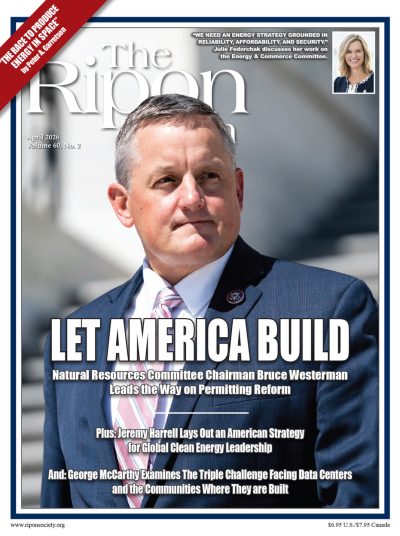
This perspective applies directly to my work on the Energy and Commerce Committee. We need an energy strategy grounded in reliability, affordability, and security—one that recognizes the essential role of dispatchable power in keeping the lights on and our economy moving.
You’ve been in office for a year and a half. What has surprised you most about the job? What has surprised me most is the pace—just how long it can take for a bill to move from introduction to the House Floor for a vote. Persistence, follow-through, and strong engagement with outside stakeholders are essential to moving policy solutions.
On a more practical note, I’ve also learned quickly that good shoes matter (a lot!). Not necessarily the cutest ones, but the ones that can handle long days and a lot of steps on marble floors.
One disappointing lesson is the challenge of building relationships with colleagues on the other side of the aisle. My favorite event to make friends with Democrat members was the Congressional Women’s Softball Game. Sports are a great bipartisan team and friend-building tool.
Who has most influenced your leadership style? Former North Dakota Governor Ed Schafer was my first boss in politics and significantly influenced my style. Ed led with common sense. He was results-oriented and really changed North Dakota from a sleepy state with few young people to a business-oriented place with a growing economy based on our incredible natural resources. He always remained in close contact with his constituents. He also had a casual style—didn’t take himself too seriously and was always fun and in good humor. We need to pursue brave, seemingly impossible tasks—and being positive and optimistic is the best way to build the coalitions needed to accomplish big things.
Finally, what one bill or initiative would you most like to see Congress pass for your constituents? One of my most important legislative efforts for North Dakota is already across the finish line. My legislation to stop the Biden administration’s Bureau of Land Management (BLM) Resource Management Plan (RMP) for our state passed both the House and Senate and was signed into law. That plan would have been devastating—costing an estimated 12,000 jobs and $34 million in annual state revenue. Completing that was critical for our workers, our communities, and our economy.
Looking ahead, I’m focused on two key priorities. First, the High-Capacity Grid Act. We need more power to meet growing demand, especially with the rise of AI and data centers. The reality is, we can’t build new infrastructure fast enough, so we must make better use of existing infrastructure. This legislation will help modernize America’s transmission system by requiring the use of best-available transmission conductors for new interstate transmission lines and rebuilds.
Second, year-round E15 and the Farm Bill. Biofuels are an important part of America’s energy dominance and another way North Dakota is helping fuel the world. I serve as Co-Chair of the Congressional Biofuels Caucus to advance policies that will help expand domestic energy production, empower rural America, and deliver practical solutions for North Dakotans. I am also on Speaker Johnson’s Rural Domestic Energy Council. This group of House Members has drafted language to provide for year-round E15 that aims to address concerns of all stakeholders. The goal is to have this bill pass both chambers of Congress so it can be signed into law by President Trump. Additionally, the Working Families Tax Cuts Act included more than two-thirds of the Farm Bill, with the rest of the Farm Bill heading to the House Floor soon. I look forward to voting in support of the package, which makes conservation programs more farmer-friendly, enhances credit provisions, and makes improvements to programs in rural America.
These are practical, results-driven efforts that will make a real difference for North Dakota families and our future.