


As Veterans Day approaches and Americans set aside a moment to contemplate the enduring role and impact veterans have played in advancing the cause of our nation’s grand experiment, this is also a good time to consider the performance of the Department of Veterans Affairs.
The VA is charged with an extraordinary responsibility. Every day it seeks to meet the health care, education, and quality-of-life needs of 18 million veterans across all 50 states and US territories around the world. Each of those veterans brings a unique history and set of needs, and the VA must marshal its resources to not only meet those needs but to help veterans thrive.
By many measures, the VA is doing better at meeting those needs.
Three Million Claims. One Big Step Forward.
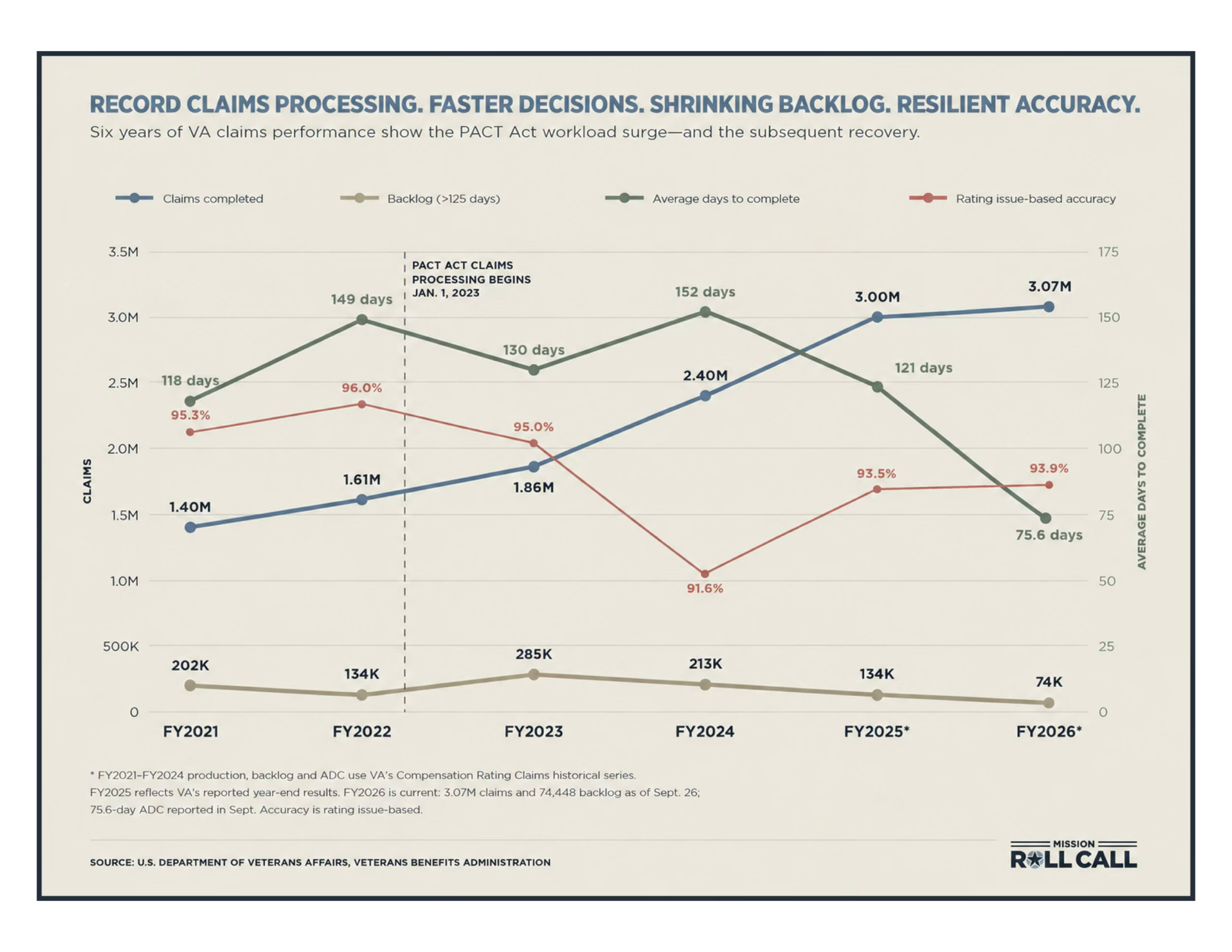
The VA has made remarkable progress processing disability claims over the past few years in the wake of the implementation of the PACT Act at the beginning of 2023. The VA is now processing more than three million claims per year and has brought the claims backlog below 75,000. While rating issue-based accuracy took a slight dip in FY24, when claims surged to 2.4 million, the VA has since returned accuracy to nearly 94 percent.
The VA’s average time to complete a claim is now about 76 days. This is far faster than the 152-day average from only a few years ago.
Perhaps more importantly, however, the VA’s average time to complete a claim is now about 76 days. This is far faster than the 152-day average from only a few years ago. The VA’s success in delivering more decisions in less time means veterans and their loved ones gain quicker access to the benefits and support they have earned.
Beyond the Backlog: Veterans Weigh In.
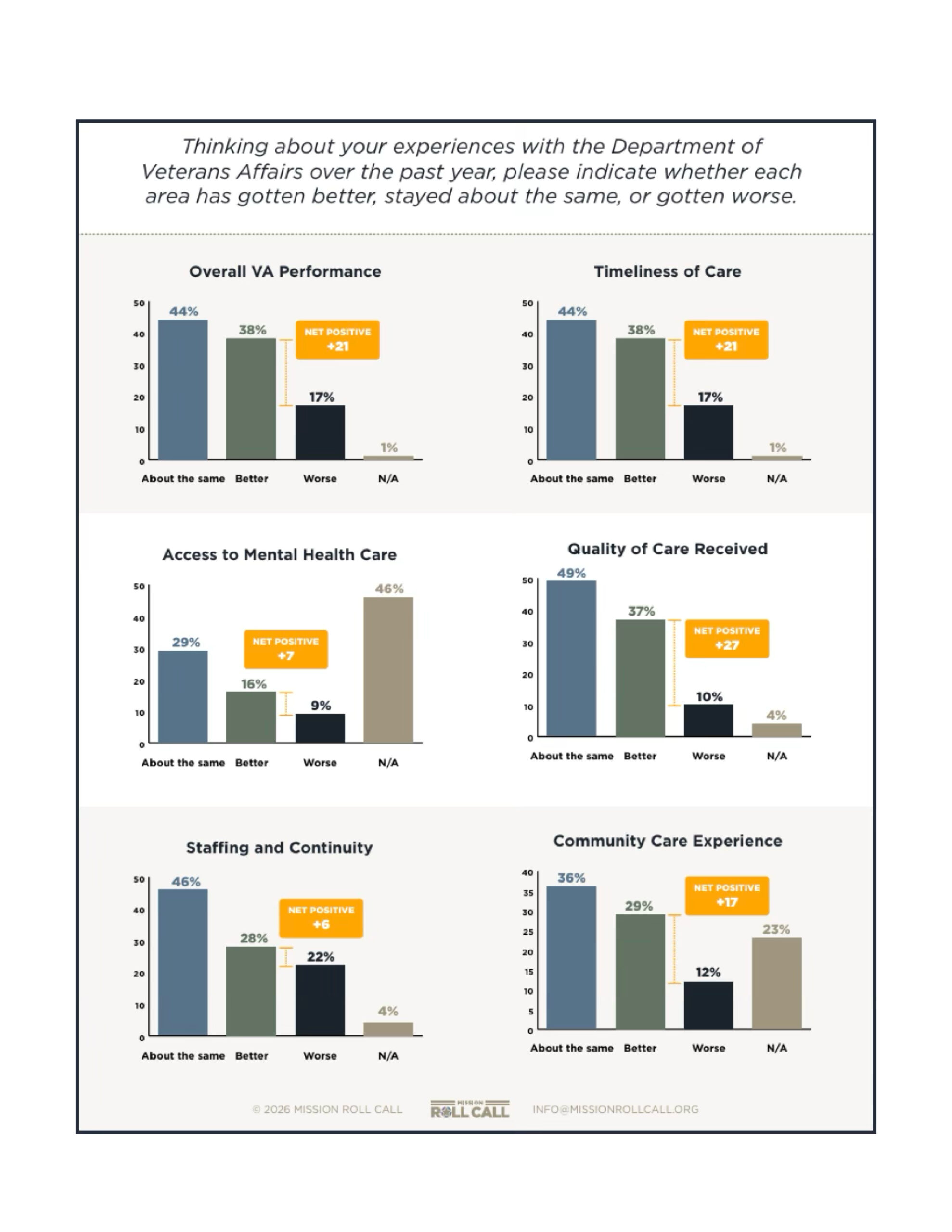
The VA’s progress extends beyond compensation and disability claims. In February 2026, Mission Roll Call surveyed more than 2,200 veterans who voluntarily shared their experiences with the VA over the previous year. Importantly, nearly three-quarters of respondents rely on the VA as their primary source of health care, giving them considerable firsthand experience with the system.
The results were encouraging. Thirty-eight percent said their overall VA experience had improved, compared with 17 percent who said it had worsened. Veterans reported the same 21-point net improvement in the timeliness of their care, while perceptions of health care quality were even stronger: 37 percent reported improvement compared with just 10 percent who believed quality had declined. Community care also registered a 17-point net improvement.
While these results reflect improvements across several important categories, they also remind us that further work remains. The VA’s mission is extraordinarily challenging. Delivering care and services to millions of veterans across more than a thousand locations requires sustained leadership and continuous improvement. No organization of this size can transform overnight, and maintaining progress while continuing to serve veterans is itself a considerable management challenge.
Faster, yes. But is it Better?
Of course, speed in delivering services and care does not necessarily mean better. Shorter wait times and quicker appointments are of little value if they come at the expense of the quality of care veterans receive. Fortunately, veterans responding to our surveys are telling us that both the timeliness and quality of care they are receiving have improved.
These perceptions are supported by independent measures of quality. In 2026, the Centers for Medicare & Medicaid Services awarded four- or five-star quality ratings to 78 percent of rated VA hospitals, the highest percentage since VA facilities entered the rating system in 2023.
Veterans responding to our surveys are telling us that both the timeliness and quality of care they are receiving have improved.
The challenge facing the VA has never been simply to move veterans through the system faster, but to make the system work better for them. Our survey suggests the VA is making progress on both fronts. Efficiency and quality do not have to be competing objectives. Veterans and their families expect the VA to deliver quality care and services within a reasonable time period, and the VA is improving in both important measures.
One VA, Many Experiences.
The encouraging national picture, however, conceals an important challenge: a veteran’s experience can still depend heavily on which VA facility they visit. There’s an old saying among veterans: “If you’ve seen one VA, you’ve seen one VA.” One veteran responding to our VA Performance survey captured the challenge particularly well:
“I think that depending on where you live has a lot to do with the care you receive. I’ve had ups and downs using VA health care and the services can be very different. Need to look at who gets it right and maybe benchmark those ideas to the VAs that do not rate as high.”
That same veteran also identified part of the solution. A system as large as the VA will inevitably see differences in performance among its facilities. The challenge is identifying what the best-performing facilities are doing right and replicating those practices across the enterprise.
Secretary Doug Collins has acknowledged this problem directly, observing that veterans should receive similar treatment whether they visit a VA facility in Colorado or Florida. Encouragingly, the VA’s ongoing reorganization of the Veterans Health Administration seeks to establish more consistent standards and performance across its facilities while giving local leaders greater authority to deliver results.
That effort deserves time to work. But most indications at the moment signal the VA is on the right track overall.
Room for Growth: Enter the Gorilla.
The VA is the proverbial 800-pound gorilla in American health care, but it doesn’t always act like one. As the nation’s largest integrated health care system, the VA has enormous purchasing power, a nationwide network of facilities, and relationships with thousands of private-sector providers. That scale presents opportunities extending well beyond improving the performance of its own facilities.
In some categories, the VA uses its position in the health care marketplace to negotiate better prices, improve access to specialty care, and encourage innovation in the delivery of services. Whether purchasing pharmaceuticals, medical equipment, or care from community providers, the VA has an opportunity to leverage its size to secure better value for veterans and taxpayers alike.
Whether purchasing pharmaceuticals, medical equipment, or care from community providers, the VA has an opportunity to leverage its size to secure better value for veterans and taxpayers alike.
However, other opportunities exist where the VA can leverage the size of the veteran community to influence the broader health care marketplace, including expanding access to specialty and mental health care, accelerating the development of advanced prosthetics and adaptive equipment, improving the interoperability of electronic health records, strengthening rural health care networks, and encouraging private-sector investment in medical research and innovative treatments.
From Momentum to Lasting Change.
The VA deserves considerable credit for the progress it has made. Record claims processing, faster decisions, and improving experiences with health care are meaningful accomplishments, reflecting the dedication of VA leadership and the thousands of professionals who serve our veterans every day.
There is still work to do, and not every veteran will experience these improvements equally. But the VA has demonstrated that meaningful change is possible, even within one of the federal government’s largest and most complex organizations. The opportunity now is to build on that success, spread what works, and keep raising expectations.
So, if you haven’t visited your local VA lately, perhaps it’s time to give it another look. You might just be surprised.
Mike Desmond is the Strategic Director of Government Affairs and Advocacy at Mission Roll Call, a U.S. Army Special Operations veteran, and a retired Intelligence Community Operations Officer.