


When I was twenty-nine, my mentor David Gergen asked me a question I have not stopped thinking about: “Do you think your generation will serve again?”
David had served in the Navy. Within his lifetime, the share of members of Congress who were veterans had fallen from over 70 percent to under 20. He believed government worked better when more of its leaders had served. Shared service builds trust, and trust makes compromise possible. A decade later, in 2017, he co-founded With Honor with Marine Corps veteran Peter Dixon and me to help answer his own question.
This year, my generation is answering it.
On November 3, Americans will go to the polls, and the parties are already arguing over what the results will mean. It may well be a wave election for one side. Whichever way it breaks, the partisan tally will not be the only story. Beneath it runs a current that neither party owns. This is a service wave.
This election cycle, 752 veterans from all 50 states have run or are running for the House and Senate.
It did not begin this year. After the 2016 election, a new generation of post-9/11 veterans began stepping into politics in growing numbers. Since 2018, With Honor has helped elect more than two hundred veterans and national security professionals to office.
This cycle builds on that foundation: 752 veterans from all fifty states have ran for the House and Senate. That is the most we have recorded since the organization was founded. It surpasses the previous high set in 2022 and is a 47 percent increase over 2024. They are running as Republicans, Democrats, and independents. Roughly four in ten served after September 11, making them the largest generation of veterans on the campaign trail. Ninety-five are women, more than double the number two years ago.
Americans seem to understand why this matters. In June, With Honor and Gallup asked how much confidence people have in military veterans. Seven in ten said a great deal or quite a lot. In the same Gallup survey, 9 percent said the same of Congress.
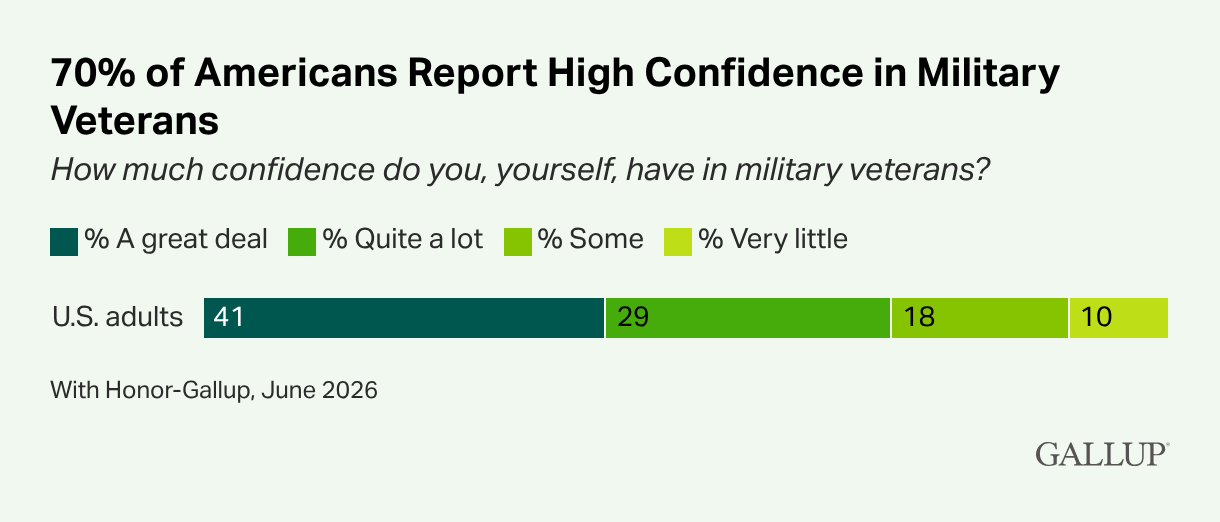
And that trust extends to elected office. Seventy-seven percent of Americans said they would trust a person with military experience to perform well as an elected official. That includes 91 percent of Republicans, 73 percent of independents, and 70 percent of Democrats. Few questions in American life still draw majorities from all three.
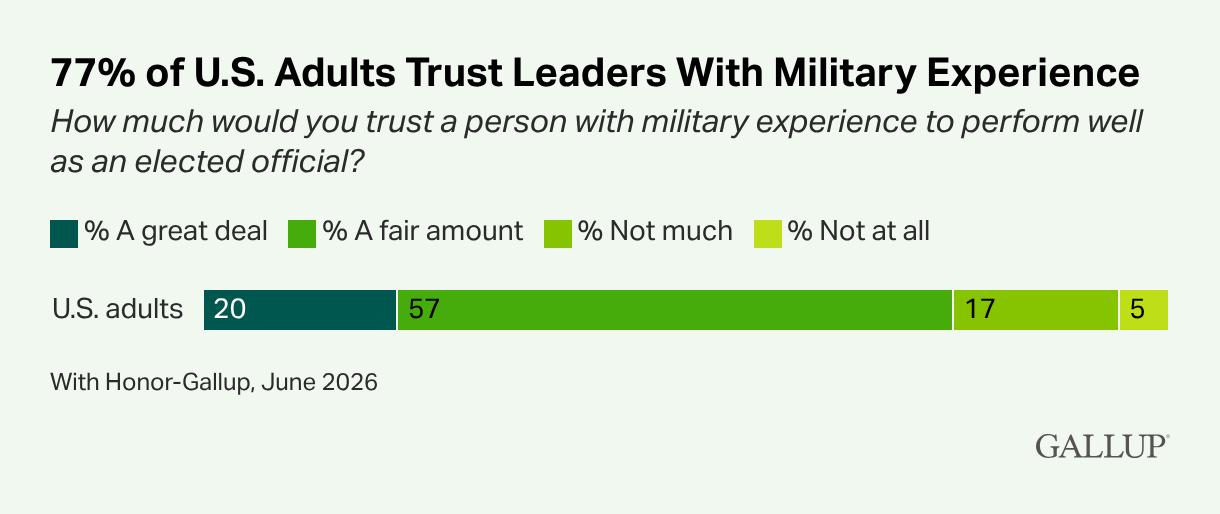
Seventy-seven percent of Americans said they would trust a person with military experience to perform well as an elected official.
Trust is not a credential, and veterans are not immune to the forces that reward outrage over governing. I have watched some of the best public servants I know pay for choosing the harder path. I profiled a number of them in my recently released book Courage Can Save US, including Marine veteran Rep. Jared Golden, a Democrat, and Rep. Don Bacon, a Republican and retired Air Force brigadier general. Both have announced their retirements from Congress. Their careers are both a warning about how often our politics punishes courage and proof of what that courage can do for Americans.
Americans did not come to trust veterans because of what they said. They came to trust them because of what they did: serving, sacrificing, and putting the mission ahead of themselves. That trust is not permanent. It has to be earned again in a different arena.
The veterans on the ballot this fall will face the same choice they faced in uniform: country or tribe. The question is not only whether they will choose well. It is whether the rest of us will recognize and reward them when they do.
Rye Barcott is a Marine Corps veteran, social entrepreneur, investor, and New York Times-bestselling author of Courage Can Save US. He is co-founder and CEO of With Honor, a cross-partisan organization that fights polarization by supporting principled veteran leadership in public office.