


Two hundred and fifty years ago, 56 men signed their names to a document that changed the world. They were not demigods. They were lawyers and merchants, farmers and physicians — men of ambition, vanity, and occasional pettiness. They argued bitterly, compromised reluctantly, and held contradictions that history has not let them escape.
And yet they produced the most successful experiment in self-government in the history of civilization. Not because they were perfect, but because they were not — and they succeeded anyway. As America marks its 250th anniversary, the leadership lessons they left behind are not a sentimental exercise. They are an urgent one.
On Compromise: Why It Worked Then — and Why It Is So Hard Now
The Constitutional Convention of 1787 was 89 sweltering days in Philadelphia during which the whole enterprise nearly collapsed. What made compromise possible is something we have largely stopped talking about: the Founders shared a common floor. Not identical beliefs — but a set of convictions that were simply not on the table. It is far easier to bargain on structure when you agree on the foundation beneath it.
The Founders agreed, across their considerable differences, that self-government required a virtuous citizenry. Freedom and virtue were not in tension. Freedom required virtue to survive.
Those convictions cut across their theological and political differences. Rights come from the Creator, not the state — a government that claims to give rights can just as easily take them away. Governmental tyranny is the permanent threat, and the entire architecture of the Constitution — separation of powers, checks and balances, the Bill of Rights — exists to prevent it. Those who hold office are accountable to a moral code above their own preferences; Washington’s Farewell Address warned that national morality cannot prevail without religious principle. And government itself answers to something higher than popular will — the Declaration appeals not only to the consent of the governed but to “the Laws of Nature and of Nature’s God.” Office was not a prize. It was a stewardship.
Today, many of these foundations are themselves the subject of our political combat. When the floor is disputed, there is nothing left to stand on together. The Founders could bargain fiercely because they agreed on what was not negotiable. We have forgotten what that feels like.
On Virtue and Freedom: Franklin’s Argument
At the Constitutional Convention, Benjamin Franklin called for prayer and humility, asking his colleagues: “Have we now forgotten that powerful friend?” Franklin had identified the deepest requirement of free government: that it rests on something beyond itself. The Founders agreed, across their considerable differences, that self-government required a virtuous citizenry. Freedom and virtue were not in tension. Freedom required virtue to survive.
Practical Politicians: Flawed Men Who Served Something Larger
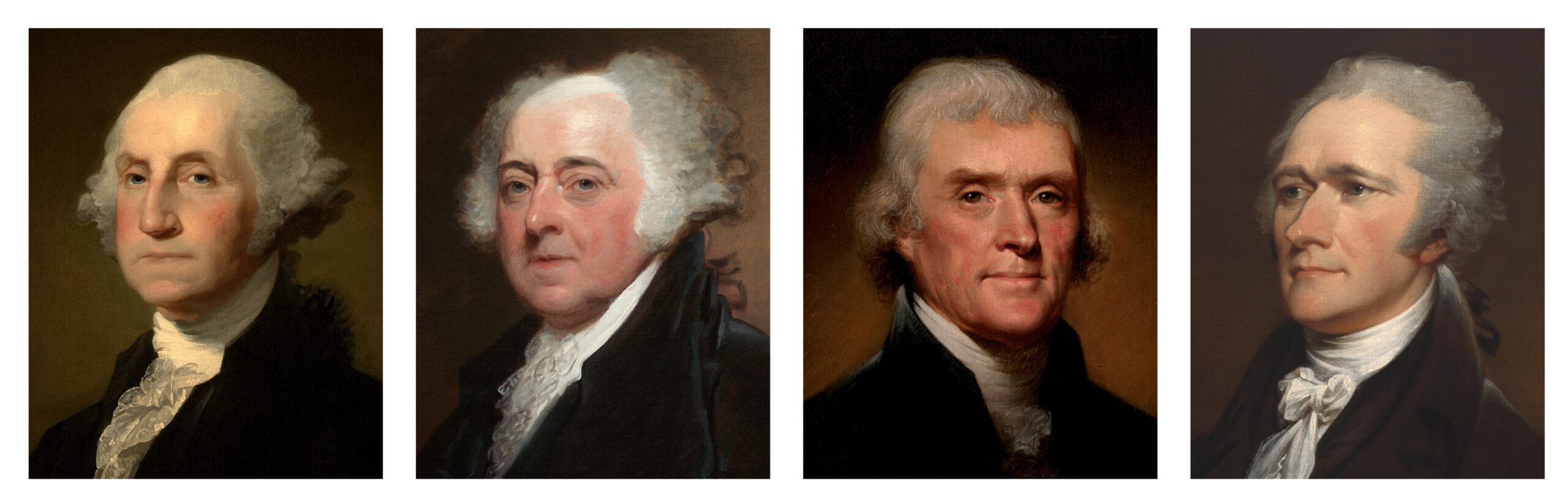
There is a temptation at moments like this one to bronze the Founders — to lift them beyond criticism or emulation alike. This is a disservice to them and to us. Adams was vain and difficult. Jefferson was deeply contradictory. Hamilton was brilliant and reckless. Washington was a man of fierce pride who had to learn, slowly, to subordinate that pride to the public good.
When self-interest is the highest value in the room, no institution is ever truly safe.
What made them great was not the absence of these qualities, but the presence of something stronger: at critical moments, they placed the republic above themselves. Washington refused a third term. Adams enforced a treaty that cost him re-election. What we need today are leaders who ask not what the office does for them, but what they owe the republic. That disposition is the engine of compromise. When self-interest is the highest value in the room, no institution is ever truly safe.
Republic, Not Democracy — and Why It Matters
The Founders were not democrats in the modern sense. They were republicans. Madison distinguished sharply between a pure democracy — which he considered incompatible with personal security and individual rights — and a republic, in which the people govern through representatives whose power is checked and whose accountability is structured.
What we are protecting is a constitutional republic, one in which majority will is real but constrained and individual rights are not subject to popular vote. The Founders had a name for the alternative. They called it mobocracy — government by appetite, passion, and the loudest faction of the moment. A republic grounded in moral order was the answer to mobocracy then. It remains the only answer now.
For Young Americans
If the Founders’ example is to inspire young Americans, it cannot be a polished myth. Young people are well-equipped to detect one, and they are right to reject a version of history that asks them to admire without questioning. The honest case is more compelling: here were men of real flaw and real greatness who built something that has outlasted every rival system attempted in the same 250 years.
Teach the founding era as it was — contested, uncertain, and finally astonishing. Let young Americans argue with Jefferson. Let them be troubled by the contradictions. Then point out what they may not have noticed: the mechanism the Founders built — amendment, deliberation, law — was designed to resolve those contradictions over time. It has. Imperfectly, slowly, often painfully. But it has.
Franklin, leaving Independence Hall in 1787, was asked what the Convention had produced. “A republic,” he said, “if you can keep it.” Keeping it requires what the Founders modeled: humility, commitment to structures that outlast our preferences, and the conviction that the republic is worth more than any single faction’s triumph. Flawed men built it. It is ours to keep.
Dory Wiley is a presidential and founding era historian, speaker, and author based in Dallas, Texas. He lectures widely on the Declaration of Independence, the Constitutional Convention, and the theological roots of the American republic.