
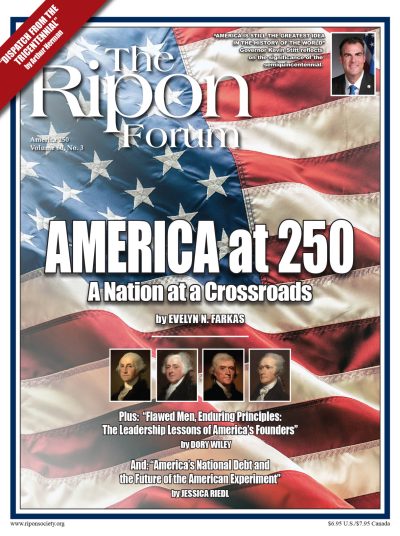

Two hundred and fifty years ago, a small group of men gathered in Philadelphia and pledged their lives, their fortunes, and their sacred honor to an idea. As America marks the semiquincentennial of that founding, this special edition of The Ripon Forum takes the measure of the country they created — where it stands, how it has changed, and what it will take to carry the experiment into its next half century.
We begin at a crossroads. “We, undeniably, find ourselves at one of the most dangerous points in American history,” writes Evelyn Farkas in the lead essay, pointing to a world in which China, Russia, North Korea, and Iran are working in concert to unravel the international order the United States built. Yet Farkas, who serves as Executive Director of the McCain Institute, remains hopeful about the road ahead. “There is a crying need,” she writes, “for a new America to lead the world into this next half century, harness all that is good and productive in our citizens, and lift up all boats at home and on foreign shores.”
If the founding offers a guide for that road, it is one rooted less in the greatness of America’s Founding Fathers than in their imperfection. “They were not demigods,” Dory Wiley writes of the men who signed the Declaration. “They argued bitterly, compromised reluctantly, and held contradictions that history has not let them escape. And yet they produced the most successful experiment in self-government in the history of civilization.” Wiley, a presidential and founding-era historian based in Dallas, argues that what united them beneath their differences was a single conviction: “Self-government required a virtuous citizenry. Freedom and virtue were not in tension. Freedom required virtue to survive.”
No accounting of the past can avoid the math of the present. “Since 2008, the federal debt has leaped from 40 to 100 percent of the economy — nearly matching the World War II peak,” writes Jessica Riedl of the Brookings Institution. The cause, she contends, is no longer war or crisis but appetite: “Never before have Americans run up so much debt in peacetime while caring so little.”
For a glimpse of where it all might lead, Arthur Herman offers a dispatch from the Tricentennial — a wry journal entry written from the vantage point of July 4, 2076. “I don’t suppose anyone foresaw the day,” Herman imagines, “when Ukraine’s high-tech economy would have to bail out a bankrupt Russia.” A New York Times bestselling author and Pulitzer finalist, Herman is the author, most recently, of Founder’s Fire: From 1776 to the Age of Trump.
The edition also looks back at the Bicentennial. Christopher Capozzola, a historian at MIT who spent July 4, 1976 on a parade float dressed as a Pilgrim, revisits how the nation marked its 200th birthday and what its embrace of “a hometown affair” can teach us now. From there, we go beyond the Beltway, where three leaders describe how their states are marking the moment: Cassandra Coleman of America250PA on Pennsylvania, Molly Fortune of the South Carolina American Revolution Sestercentennial Commission on the often-overlooked Southern campaign, and Lynn Forney Young of the U.S. Semiquincentennial Commission on Texas. Two essays consider who the American promise has been for: Ja’Ron Smith, a former senior advisor in the Trump White House, traces the long and often-forgotten history of Black Americans and the Republican Party; and, Carrie Lukas, president of Independent Women, makes the case that women — Republican women in particular — have much to celebrate at America’s 250th.
We close with a question and a portrait. In our debate, Adam Michel of the Cato Institute argues that the American Dream is being lived every day, while cultural commentator John Mac Ghionn counters that, for too many, it has become a nightmare. And in our Ripon Profile, Oklahoma Governor and National Governors Association Chair Kevin Stitt reflects on the milestone with characteristic conviction: “America is still the greatest idea in the history of the world.” Rounding out the edition are two charts from our staff — one tracing how Congress has changed since the Bicentennial, the other a snapshot of how the country itself has changed since 1976.
We hope you enjoy this America 250 Special Edition of The Ripon Forum, and, as always, we welcome any questions or comments you may have.
Lou Zickar
Editor of The Ripon Forum
louzickar@riponsociety.org