

Latest Ripon Forum assesses the political landscape for Republicans heading into the fall
With essays by David Winston & Myra Miller, Matt Gorman, and Andrew Busch; plus, remembering 9/11 and a profile of U.S. Rep. Michael Baumgartner
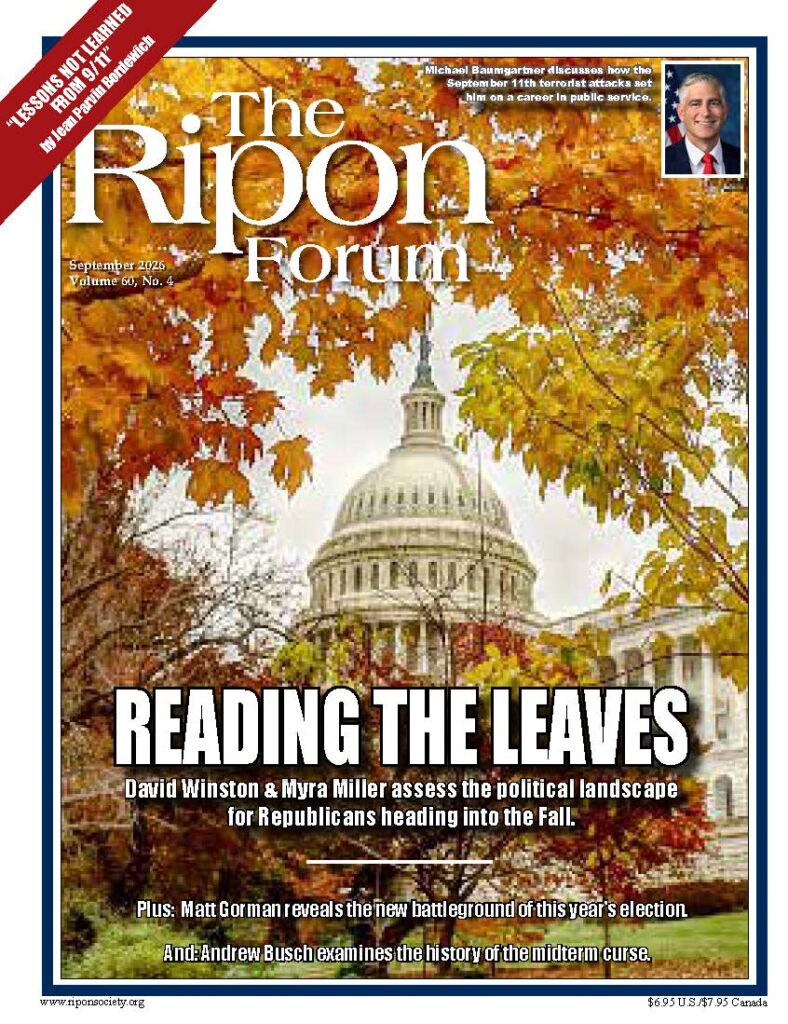
WASHINGTON, D.C. — With the 2026 midterm elections now less than two months away, the latest edition of The Ripon Forum examines the political landscape for Republicans heading into November, the new battleground for candidates in this year’s campaign, and the history of the midterm curse that so often bedevils the incumbent president’s party.
“In the midterm election,” write veteran GOP pollsters David Winston & Myra Miller in the cover essay for this latest edition, “voters will assess whether Republicans have made progress in addressing their priorities. Numbers from our June survey indicate a challenging environment … President Trump’s job approval could pose a headwind for many Republican candidates in competitive districts.”
That said, the pair also write that there is a pathway for GOP candidates to win in November by focusing on one of the lesser-known accomplishments of the One Big Beautiful Bill passed last year. “Republicans have focused more of their messaging around no tax on tips and overtime,” Winston and Miller write, “but their biggest opportunity to show how the bill prevented a tax increase may be the standard deduction, which the Treasury Department says over 127 million tax filers claimed in 2025.”
In another essay geared around the political landscape, Matt Gorman, Chief Communications Officer of Targeted Victory, examines how political communication has been transformed. “The communications playbook has been rewritten,” Gorman writes. “Not because television disappeared or newspapers stopped mattering. But because campaigns no longer decide where voters get their information.” He argues that authenticity, not message discipline, now determines who wins the fight for attention — which, he contends, is now “the real battleground in modern politics.”
Andrew E. Busch, Professor and Associate Director in the Institute of American Civics in the Howard H. Baker Jr. School of Public Policy and Public Affairs at the University of Tennessee, examines the history of another factor that is expected to come into play this election — the midterm curse. “From 1894 through 1990, midterm elections produced a change in the party majority in at least one house of Congress in six of 25 elections. Seven of the eight midterm elections between 1994 and 2022 did so. Will 2026 repeat the normal midterm pattern or join the ranks of the rare exceptions? There are good reasons for Republicans to fear the worst.”
In other essays examining the upcoming election, Forum Deputy Editor Caroline Banaszak-Thomas profiles rising Republican candidates to watch across House, Senate, and gubernatorial races, and Ethan Rosier, a Frenzel Fellow at The Ripon Society, examines how Gen Z voters may reshape the electoral map.
As America prepares to mark the 25th anniversary of the September 11, 2001, terrorist attacks, this edition also reflects on the enduring lessons of that day. Shilo Brooks, President and CEO of the George W. Bush Presidential Center, writes movingly about the unity that followed the attacks. “The unity of our nation after 9/11 showed what is best in the American spirit, and reminded us what it means to embrace each other as fellow Americans,” Brooks observes, arguing that this same spirit remains available to us today without requiring another tragedy to summon it.
Jean Parvin Bordewich, President of Guilford College and a former member of the second Continuity of Government Commission, warns that critical lessons from that day remain unlearned. “Imagine the political uproar if Speaker Nancy Pelosi succeeded President Donald Trump, or Speaker Mike Johnson replaced President Joe Biden should both President and Vice President have been killed,” she writes, making the case that Congress must finally reform presidential succession law.
In other essays, Charles Blahous of the Mercatus Center argues that Social Security’s fiscal challenges deserve far more attention than they’re receiving on the campaign trail. Walter Olson of the Cato Institute explains why the Framers wanted the states, and not Washington, to control congressional elections. David French of the National Retail Federation exposes the latest effort by trial lawyers to abuse the nation’s legal system through frivolous lawsuits.
And in the latest Ripon Profile, Congressman Michael Baumgartner of Washington reflects on how 9/11 impacted his life and launched him into a career of public service.
The Ripon Forum is published six times a year by The Ripon Society, a public policy organization that was founded in 1962 and takes its name from the town where the Republican Party was born in 1854 – Ripon, Wisconsin. One of the main goals of The Ripon Society is to promote the ideas and principles that have made America great and contributed to the GOP’s success. These ideas include keeping our nation secure, keeping taxes low and having a federal government that is smaller, smarter and more accountable to the people.