



As we typically see in a midterm cycle for the incumbent president’s party, midterm elections can be difficult. Republicans are in a challenging position, but 2026 is not a foregone conclusion.
Many say it’s all about turnout, but recent elections have shown independent voters increasing in size and influence. Exit polls show that independents increased 7 points from 2020 to 2024, eclipsing Democrats as a percentage of the electorate. Independents surpassed Democrats in 5 out of 7 competitive presidential states including Michigan, North Carolina and Arizona — states with competitive races this cycle.
Will There Be A Blue Wave?
Whether Democrats get their Blue Wave will largely depend on the margin among independents. In 2018, Democrats won independents by +12D, producing the Blue Wave. In 2022, Republicans had their best party ID advantage in the history of exit polling (+3), but the Red Wave was blunted by GOP underperformance among independents (+2D).
As we saw in last November’s gubernatorial elections in Virginia and New Jersey, there are signs that Democrats could be recreating the 2020 Biden coalition. In Virginia, independents made up 33 percent of the electorate. Abigail Spanberger won independents by 19 points, the same margin as Biden’s in 2020 and a reversal of Glenn Youngkin’s 9-point margin in 2021. In New Jersey, Sherrill carried independents by 13 points (56-43).
Whether Democrats get their Blue Wave will largely depend on the margin among independents.
While there are factors that work in Democrats’ favor, one of the biggest obstacles to a Blue Wave is that the image of Congressional Democrats is negative overall (38-56 favorable-unfavorable in our June 2026 survey for Winning the Issues) and among independents (30-62). The image of Congressional Republicans is 37-58 favorable-unfavorable, on par with that of Democrats (38-56); among independents, the Republican image is 25-68. Among independents, 42 percent have an unfavorable view of both Republicans and Democrats, meaning both parties will be competing for a group that has a negative image of both.
What The Midterms Are About
We see two central factors shaping what the midterms will be about.
1) The economy — During the Biden administration, when prices increased over 21 percent, the economy was a strong advantage for Republicans. Republicans held a +12 advantage on handling inflation and +11 on the economy (2024 Post-Election Survey for Winning the Issues). Our Winning the Issues June 2026 survey shows those leads have dissipated to -9 on inflation and -6 on the economy.
In 2024, Republicans were elected to fix the Biden economy. In the midterm election, voters will assess whether Republicans have made progress in addressing their priorities. Numbers from our June survey indicate a challenging environment.
- While 11 percent of voters say the economy is improving at an acceptable rate, 26 percent it is improving at an unacceptable rate. 60 percent say it is not improving at all.
- 66 percent say inflation is getting worse rather than better (16 percent) or not changing (17 percent).
- 73 percent say cost of living is increasing faster than their wages, compared to wages increasing faster (6 percent) or that they are increasing at about the same rate (17 percent).
While there are factors that work in Democrats’ favor, one of the biggest obstacles to a Blue Wave is that the image of Congressional Democrats is negative overall.
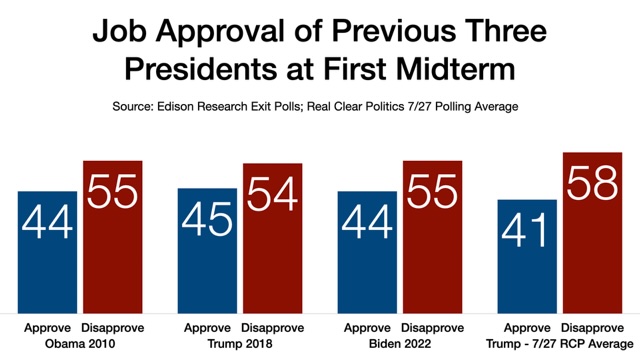
2.) Presidential job approval — Looking at the job approvals of the last three presidents in their first midterms (from exit polls: Obama 2010, 44-55; Trump 2018, 45-54; Biden 2022, 44-55), President Trump’s job approval (41-58 according to the RCP average 7/27) could pose a headwind for many Republican candidates in competitive districts. But that doesn’t mean that a Republican candidate cannot survive a difficult presidential job approval. Senator Susan Collins won a stunning re-election victory in 2020 with a 9-point margin despite President Trump losing Maine by 9. Her key to success was building a broad majority coalition base of support, including 18 percent of Biden voters and 23 percent of voters who disapproved of President Trump.
In 2022 under President Biden, some Senate Democratic incumbents in difficult races managed to survive re-election despite an unpopular president with negative job approvals in their states — examples being Mark Kelly (AZ) and Catherine Cortez Masto (NV).
Lessons From 2018
The 2018 midterm election, in which Democrats got their Blue Wave by winning independents by 12 and women by 19, is a model for what not to do in a election. Republicans should heed lessons from those losses. Our data indicates that there were missed opportunities in 2018. One of those was around the 2017 Tax Cuts And Jobs Act — a signature economic accomplishment that Republicans could have promoted to their advantage.
From our 2018 Winning the Issues post election research:
- The state of the economy had the potential to be an asset to Republicans, with 68 percent of voters calling the economy excellent or good, an improvement from 2016 when only 36 percent called it excellent or good.
- 36 percent of the electorate said the bill will lower taxes for people like them. (42 percent will not, 23 percent didn’t know).
- Those people who said it would lower their taxes voted Republican 73-26. If Republicans could have increased the size of this voter group, it would have helped significantly.
- By 2:1, the combination of the immigration and the caravan issues dominated the Republican economic message that voters heard.
Republicans were not able to make the number one issue – the economy – the number one issue. This November, Republicans have another opportunity to get it right and deliver on voter concerns around affordability.
The GOP Opportunity
One of Republicans’ best opportunities to address voter economic concerns is their signature tax bill, the Big Beautiful Bill. Views of the bill are clearly defined around whether people think it prevents a tax increase on them. From our June survey for Winning the Issues, voters who thought it did prevent a tax increased favored it 73-22. Those who thought it did not prevent a tax increase opposed it 22-72.
One of Republicans’ best opportunities to address voter economic concerns is their signature tax bill, the Big Beautiful Bill.
Republicans have focused more of their messaging around no tax on tips and overtime, but their biggest opportunity to show how the bill prevented a tax increase may be the standard deduction, which the Treasury Department says over 127 million tax filers claimed in 2025.
Looking Ahead To November
Republicans will want to tie Democratic candidates to extreme socialist figures like Zohran Mamdani. That may set a helpful context in many races, but may have limited success in campaigns where Republicans face moderate Democratic candidates. Given the remaining economic challenges, Republicans have a responsibility to deliver on what they promised in 2024 and define additional steps to build upon the progress they have made.
David Winston is the President of The Winston Group, a Washington, D.C., strategic planning and survey research firm. Myra Miller is the firm’s Co-Founder. Myra and David are co-hosts of the Discussion Points podcast, available on YouTube.