




In 2020, Joe Biden won the youth vote by 25 points over Donald Trump. Four years later, Vice President Kamala Harris lost significant ground in that same group, carrying it by only 4 points. With the 2026 midterm elections just around the corner, experts are still trying to figure out where the generation’s political loyalties lie. Ask 1,000 Gen Zers about their politics, the issues that animate them, and how eager they are to engage with government, and you’ll get no shortage of different answers. In 2024, 47 percent of eligible youth voters (ages 18-29) cast a ballot, a dip from 2020’s historic 50 percent, but still a sharp improvement over 2016’s 39 percent. That raises two questions: what issues drive Gen Z to the polls, and does the rightward swing in 2024 reflect a lasting political realignment?
Tufts Center for Information & Research on Civic Learning and Engagement (CIRCLE) published an April report which identified cost of living and inflation, healthcare, and housing costs as the top three issues Gen Z is looking to their elected officials to address. Young Americans are growing worried about their future ability to purchase a car, own a home, and afford healthcare – not to mention a shrinking Social Security fund. The issues that won Trump significant support from young voters in 2024 are the same ones his leadership will be judged on in 2026.
Notably, foreign policy and humanitarian crises abroad ranked last among listed choices, perhaps signaling President Trump’s “America First” 2024 campaign message continues to resonate with this generation two years later. Despite ongoing foreign conflicts, young Americans want their government focused on the issues at home. As domestic issues remain a top priority for Gen Z, the upcoming midterm elections will be a turning point in the generation’s political engagement. Whoever treats these voters as an afterthought does so at their own risk. Those same anxieties help explain why so many young men swung toward Trump in 2024 — the open question is whether that shift holds through November, or reverts.
The party hasn’t just lost young men on policy, it has lost the ability to speak their language.
This rightward swing was most pronounced among young men aged 18-29. CIRCLE’s 2024 election report showed a 29-point swing in the margin of support for President Trump among young men, who ultimately backed him by 14 points over Vice President Harris. Harvard’s John Della Volpe attributed this shift to young men feeling like the Democratic Party “doesn’t speak to them.” Della Volpe is onto something: the party hasn’t just lost young men on policy, it has lost the ability to speak their language.
While President Trump earned the support of young men and made inroads with Hispanics in 2024, it’s uncertain whether that support will hold for Republicans in November. The data suggests the demographic is already splintering by age. Among men aged 23-29, Trump’s net approval rating has dropped 9 points since 2025, and Democratic support on the generic ballot has climbed 14 points on margin, according to the Spring 2026 Yale Youth Poll.
However, the youngest men in this demographic, aged 18-22, are behaving differently. Despite growing disapproval of the President, the youngest men are not ready to commit to Democrats in November. President Trump’s approval rating among men aged 18-22 has dropped 8 points, while their support for Democrats on the generic ballot has slipped by just 1 point. Young women show no such hesitation; Democratic generic ballot support rose 17 points on margin among women 18-22 and 10 points among women 23-29 over the same period. That said, these are narrow subgroup breakdowns, so the direction of the trend matters more than the precise numbers.
Among Hispanic voters, President Trump is losing support – 25 percent of Hispanics who voted for him in 2024 would not do so again, a UnidosUS Bipartisan Poll found. The same poll showed Democrats leading the generic ballot among Hispanic voters 54 percent to 27 percent, with 19 percent of voters undecided. A key group of voters that sent Trump back to the White House are less likely to support his candidates in November if they vote at all.
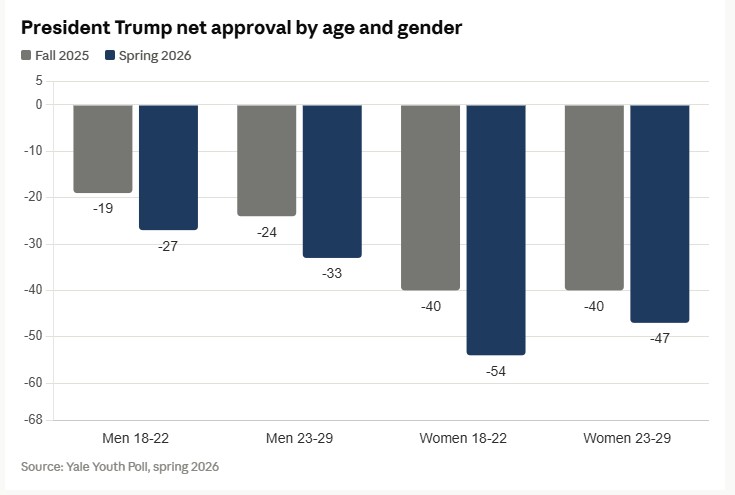
Despite growing disapproval of the President, the youngest men are not ready to commit to Democrats in November.
A CIRCLE poll found that 56 percent of those aged 18-29 are extremely likely to cast a ballot in November. The same poll showed that 35 percent of respondents said they “participate because I dislike the way politics works right now and I want to change it.” Gen Z is growing frustrated with both political parties, CIRCLE found that 22 percent of young Americans identify as pure independents; and that number jumps to 43 percent including leaners.
While Democrats currently hold the generic ballot lead, Gen Z has made it known that the Democratic party has not fully earned their support. For Democrats, the midterms are an opportunity to gain ground lost with young men in 2024. To earn the support of these young men, Democrats will need to speak to the economic anxieties that pushed many towards Trump in the first place. The growing popularity of DSA (Democratic Socialists of America) candidates signifies a desire for something different than establishment politics, especially among young Democrats. It will certainly be an uphill battle for DSA candidates endorsed by NYC Mayor Zohran Mamdani or Senator Bernie Sanders to earn the young male vote in November. Democrats have the opportunity to win back young men — just not through Mamdani or Sanders as the messenger.
While Democrats currently hold the generic ballot lead, Gen Z has made it known the Democratic party has not fully earned their support.
For Republicans, the midterms are a chance to secure the young male and Hispanic vote President Trump earned in 2024. With key parts of Trump’s 2024 coalition — young men and Hispanic voters — having second thoughts about him, it remains to be seen whether the voting bloc realignment that delivered a Republican trifecta in 2024 is set in stone. According to a recent Washington Post-Ipsos poll, Trump is currently boasting a 52 percent approval rating among Republican-leaning independents. The evidence increasingly indicates that this newfound support is currently only borrowed and these voters are not yet consistent supporters of the GOP. For Republicans, the base isn’t an issue, the edges are. If Trump can’t keep his own loosely-committed voters in line, betting on a durable youth realignment starts to look like wishful thinking.
The real story to watch this November isn’t which party wins Gen Z, but whether that win has staying power. Turnout intent is holding – this isn’t a politically passive generation. If the same percentage of voters that swung to the right of the political spectrum in 2024 now swing to the left only two years later, that swing won’t reflect a lasting ideological realignment or coalition-building so much as which party’s messaging resonated with Gen Z at this particular moment. Whichever party comes out on top in November will have to deliver on their promises if they truly want to earn this generation’s vote, not simply borrow it.
Ethan Rosier is a Frenzel Fellow at The Ripon Society & Franklin Center, and is a graduate student at the University of Maryland where he is studying Applied Political Analytics.