


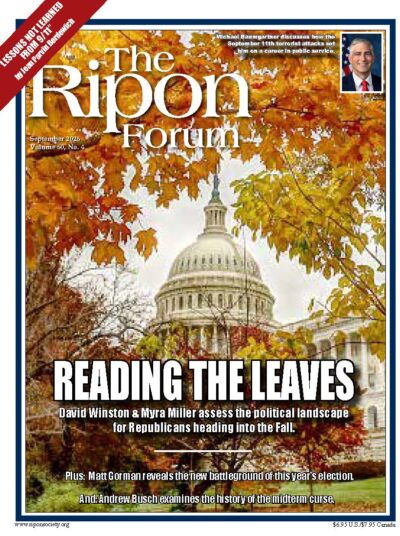


One of the most consistent patterns in American politics is the tendency of the president’s party to lose seats in Congress in the midterm elections.
This pattern is most pronounced in the House of Representatives, where the president’s party has lost ground in all but three midterm elections since 1894. There are more frequent exceptions in the Senate, but even there the president’s party has lost seats about two-thirds of the time. Whatever solace presidential parties may take from the more mixed results in Senate races is given back when reviewing elections for state governors: only a dozen states hold their gubernatorial elections in presidential years. The rest are scheduled with the congressional midterms or (in a handful of cases) odd-year state elections. The pattern there mimics the congressional pattern.
There is a simple reason House results are more consistently negative toward the president’s party than Senate results. Every House district holds an election in every midterm year (as well as in every presidential election year), but because of the Senate’s staggered six year terms, only one third of the Senate, hailing from two-thirds of the states, are up for election at any one time. Depending on which states are holding elections, the Senate can find itself largely insulated against negative national trends against the president in a way the House cannot. In 2018, Donald Trump’s Republicans lost 41 seats and their majority in the House, but actually gained two seats in the Senate because they enjoyed a “good map.”
The average midterm seat change for the president’s party since 1934 has been a loss of 27 seats in the House and 3.4 seats in the Senate.
Overall, the average midterm seat change for the president’s party since 1934 has been a loss of 27 seats in the House and 3.4 seats in the Senate. The biggest House losses in the period were 72 seats in 1938 (Franklin Roosevelt), 63 in 2010 (Barack Obama) 56 in 1946 (Harry Truman), 54 in 1994 (Bill Clinton), 48 in 1958 (Dwight Eisenhower) and 1974 (Gerald Ford), and 47 in 1966 (Lyndon Johnson). The three exceptional years, when the president’s party actually gained a tassel of seats, were 1934 (FDR), 1998 (Clinton), and 2002 (George W. Bush). A near-exception was in 1962, when JFK’s Democrats lost only 4 seats. What those years had in common were unusually popular presidents in the midst of extraordinary circumstances: Depression, an unpopular impeachment attempt, and the wake of 9-11 and the Cuban Missile Crisis. Senate midterm blowouts have included losses of 13 in 1958 (Eisenhower), 12 in 1946 (Truman), 9 in 1942 (FDR) and 2014 (Obama), and 8 in 1986 (Ronald Reagan) and 1994 (Clinton). In 8 of 23 midterm elections since 1934, presidential parties have gained Senate seats or held their own.
Political scientists have spilled a great deal of ink trying to explain the midterm curse. One theory, dubbed “surge and decline,” notes that midterm election turnout tends to be lower than presidential turnout, and posits that it is the president’s supporters who are more likely to fall off between elections. On the other hand, those most bitterly opposed to him are more likely to be mobilized. Another theory focuses on presidential approval and economic indicators to explain not the persistent House losses but the variation in size of the losses. Some argue the effect is indirect, as incumbents, challengers, and donors all calculate whether they expect the president’s party to have a “good year;” if not, more incumbents retire, more strong challengers take a pass to wait for a better year, and the discouraged the party donors become.
But what difference does the midterm curse make? Most obviously, the president’s agenda faces tougher sledding in Congress. Midterm elections also affect the next presidential election. The opposition party gains a jolt of momentum, though flexible presidents (like Bill Clinton) are sometimes forced to adapt and retreat to more defensible ground. Over a longer time horizon, the midterm curse assures an infusion of new leadership into the opposition party, contributing to party balance over time. To cite just one example, four Republican presidents elected between 1968 and 2000 owed much to a single midterm election, the 1966 drubbing of Lyndon Johnson’s Democrats: Ronald Reagan and George H.W. Bush enjoyed their first electoral successes that year, George W. Bush was launched largely by his father’s career, and Richard Nixon attributed his 1968 comeback partly to his successful nationwide campaign for Republican candidates in 1966.
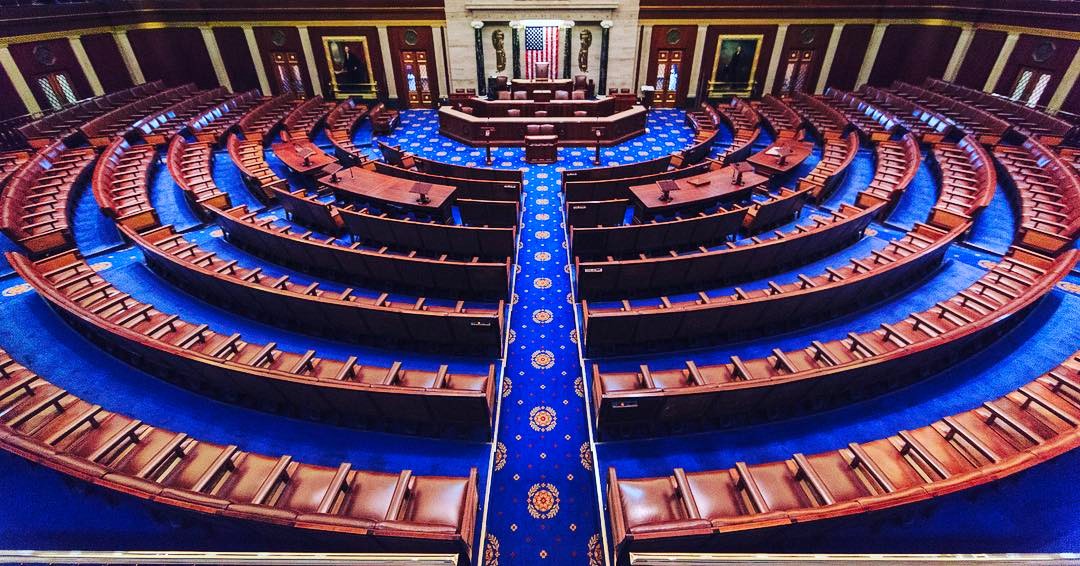
What difference does the midterm curse make? Most obviously, the president’s agenda faces tougher sledding in Congress. Midterm elections also affect the next presidential election.
Although they have always been important, midterm elections have gained outsized significance in recent years because the balance of power between the parties has been so tight. From 1894 through 1990, midterm elections produced a change in the party majority in at least one house of Congress in six of 25 elections. Seven of the eight midterm elections between 1994 and 2022 did so.
Will 2026 repeat the normal midterm pattern or join the ranks of the rare exceptions? There are good reasons for Republicans to fear the worst. Democrats hold a sizeable lead in the national House generic polls, a large number of Republican retirements have opened up new Democratic opportunities, the president’s approval ratings are hovering around 40 percent, and many indicators of voter enthusiasm show a Democratic advantage. Moreover, Republican support among Hispanics, which surged in 2024, seems to be subsiding.
There are three factors that could mitigate Democratic gains. First, even with Republican retirements, there are relatively few districts (between 16 and 35) deemed competitive by analysts. Second, Democrats may undercut themselves by association with socialist and anti-Semitic extremism. Finally, recent Republican redistricting efforts may limit GOP losses. Some analysts estimate Republicans may add up to ten seats to their final number by that route. However, that estimate is extrapolated from 2024 presidential votes, and the gains on paper are won by diluting GOP strength in favorable districts in order the grow the number of districts with a Republican majority. In the event of a Democratic wave election, that strategy could backfire spectacularly. (A decisive U.S. victory in Iran before November could also help Republicans, but may not do more politically than stop the bleeding.) All in all, Republicans will need everything to break their way to avoid losing the handful of seats that Democrats need to claim a House majority. The Senate is likely to be the real battleground. In the summer of 2026, the upcoming election looks more likely to be a typical midterm than an exception.
Andrew E. Busch is Professor and Associate Director in the Institute of American Civics in the Howard H. Baker Jr. School of Public Policy and Public Affairs at the University of Tennessee. He has authored, co-authored, or edited more than two dozen books, including Horses in Midstream: U.S. Midterm Elections and Their Consequences.